Korean Taxi Phrases: Show Your Destination, Ask Questions, and Pay with Confidence
Taking a taxi in Korea without speaking Korean? Short phrases to show your destination, answer the driver's questions, explain luggage and passengers, ask about time and fares, request a safe stop, and confirm payment and receipts, plus a practice conversation.
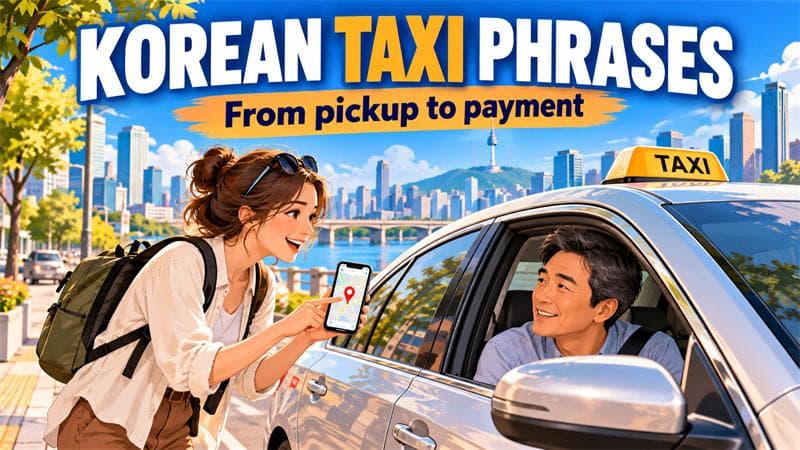
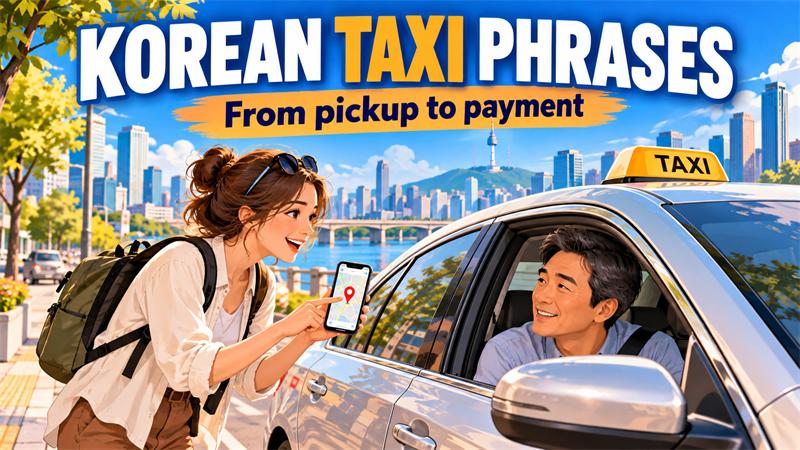
You are tired, carrying bags, and ready to take a taxi. You have the hotel name on your phone, but you are not sure how to explain where you want to go.
The good news is that you do not need to describe the whole route in Korean. A clear destination and a few short phrases can help you handle the main parts of the ride.
This guide is about everyday communication. It does not assume that every driver speaks English or that every taxi uses the same booking and payment system. Save the Korean lines you need and show them together with your destination.
1. Prepare the exact destination before getting in
Save the destination’s Korean name, street address, and map location. If a hotel or business has several branches, check the branch as well. For a station, it may help to identify the entrance you actually need.
Do not rely only on an English brand name. Even a familiar name may refer to more than one place.
| What you want to say | Korean to show |
|---|---|
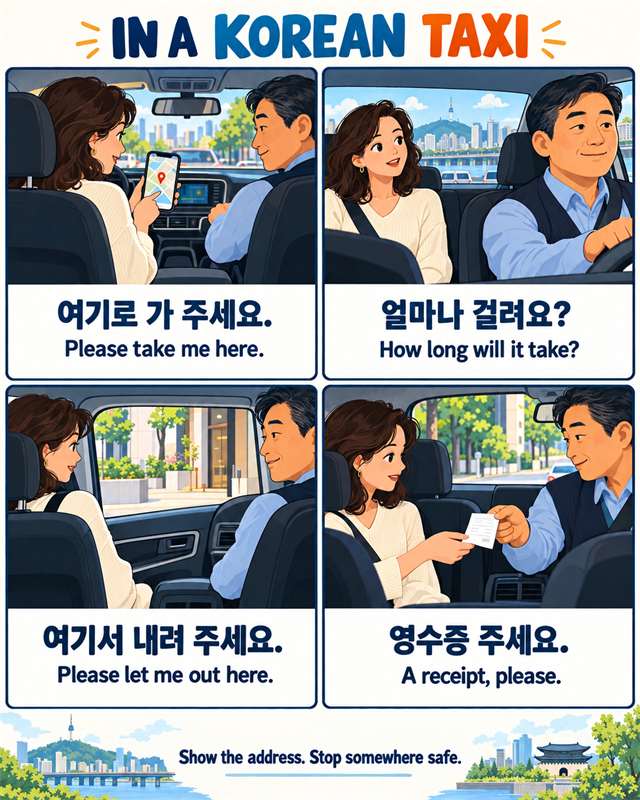
| Please take me here. | 여기로 가주세요. |
| Please take me to this address. | 이 주소로 가주세요. |
| This is the hotel I am going to. | 제가 가려는 호텔은 여기예요. |
| Please check the destination. | 목적지를 확인해 주세요. |
| Please take me to the main entrance. | 정문으로 가주세요. |
Use 여기로 가주세요 while showing the actual location. The word “here” is useful only when the driver can see what you mean.
If you booked through an app, compare the driver and vehicle details with your booking before boarding. Also check that the app’s destination is the place you intended, not just a nearby search result.
2. Recognize a question about where you are going
A driver may ask 어디로 가세요? or 어디 가세요? Both ask where you want to go.
You can answer with the destination name plus 가주세요, or show the saved address and say 여기로 가주세요.
If you do not understand the next question, use one of these:
| Situation | Korean |
|---|---|
| Please say that again. | 다시 말씀해 주시겠어요? |
| Please speak a little slowly. | 조금 천천히 말씀해 주세요. |
| I do not speak Korean well. | 한국어를 잘 못해요. |
| May I show you the address? | 주소를 보여드려도 될까요? |
Show your phone before departure or at a suitable moment rather than expecting the driver to read a small screen while moving. Prepare the address at a readable size so the exchange can be brief.
3. Explain luggage and the number of passengers
If you have a suitcase, ask where to put it rather than assuming it will fit wherever you prefer.
트렁크에 짐을 넣어도 될까요?
May I put my luggage in the trunk?
짐 means luggage or belongings. 트렁크 means the trunk or boot of the vehicle.
For a group, 세 명이에요 means “There are three of us,” and 네 명이에요 means “There are four of us.” Passenger and luggage capacity depend on the vehicle, so choose an appropriate booking option or ask before committing to the ride.
If someone needs more time getting in, you can say 잠시만 기다려주세요 (“Please wait a moment”). Once everyone is seated and ready, 출발해 주세요 means “Please go ahead.” Wear your seat belt for the journey.
4. Ask about time and charges without treating an estimate as a promise
Two practical questions are:
얼마나 걸릴까요?
About how long will it take?요금은 대략 얼마 정도 나올까요?
Approximately how much will the fare be?
대략 means approximately. Traffic and the route can affect the journey, so these questions ask for an estimate rather than a guaranteed result.
Most ordinary taxi rides in Korea use a meter, and fares differ by city and taxi type. Do not apply a price from one city or service to every ride.
Useful words include 기본요금 (base fare), 추가 요금 (additional charge), 통행료 (toll), and 할증 (surcharge).
If you want to understand an extra amount, ask:
이 금액은 어떤 요금인가요?
What is this charge for?
For a booking that quotes a fare, you can ask 통행료가 포함되어 있나요? (“Are tolls included?”). Check the booking conditions rather than assuming every quoted amount includes the same items.
5. Make a simple request during the ride
A small comfort request can be short and polite.
| Request | Korean |
|---|---|
| Could you turn the air conditioning down a little? | 에어컨을 조금 줄여주실 수 있나요? |
| Could you turn the air conditioning up a little? | 에어컨을 조금 더 세게 해주실 수 있나요? |
| May I open the window a little? | 창문을 조금 열어도 될까요? |
| Could you turn the volume down a little? | 소리를 조금 줄여주실 수 있나요? |
| Could you drive a little more slowly? | 조금 천천히 가주실 수 있나요? |
If you realize you selected the wrong destination, explain it promptly:
목적지를 바꾸고 싶어요. 이 주소로 갈 수 있을까요?
I would like to change the destination. Can we go to this address?
For an app-booked ride, the destination may also need to be updated in the app. Follow the service’s instructions and confirm the change with the driver. A change may affect the route and fare.
6. Ask to stop somewhere suitable
여기서 내려주세요 means “Please let me out here.” It is useful, but the exact spot may not be suitable for stopping.
A more flexible request is:
근처에 안전하게 세울 수 있는 곳에서 내려주세요.
Please let me out somewhere nearby where you can stop safely.
For an entrance, you can say 입구 근처에서 내려주세요 (“Please let me out near the entrance”). Avoid waiting until the last second to point across several lanes.
Before opening the door, wait until the vehicle has stopped and check your surroundings. If your bags are in the trunk, remind the driver with 트렁크에 짐이 있어요 (“I have luggage in the trunk”).
7. Confirm payment and ask for a receipt
If you plan to pay in the vehicle, 카드로 결제할 수 있나요? means “Can I pay by card?” Asking before the journey is useful if you are relying on a particular method.
Card and cash are common payment options, but that is not a guarantee that your particular overseas card or phone-payment service will work. Have a backup method and check the available options.
If your booking uses automatic payment, confirm that arrangement before paying again in the vehicle. You can ask:
앱에서 자동으로 결제되는 건가요?
Will this be paid automatically through the app?
For a receipt:
영수증 주세요.
A receipt, please.
You can also say 결제 내역을 확인해 주세요 (“Please check the payment details”) if you are uncertain about the transaction. An app may provide a trip or payment record, so check that as well when relevant.
Before leaving, look for your phone, wallet, shopping bags, and luggage. Keeping the receipt or trip record makes it easier to identify the ride if you later need help with a forgotten item.
8. A short practice conversation
Driver: 어디로 가세요?
Where would you like to go?
You: 이 주소로 가주세요.
Please take me to this address.
You: 트렁크에 짐을 넣어도 될까요?
May I put my luggage in the trunk?
Driver: 네.
Yes.
You: 카드로 결제할 수 있나요?
Can I pay by card?
Driver: 네, 가능해요.
Yes, you can.
Later, near the destination:
You: 입구 근처에서 내려주세요.
Please let me out near the entrance.
After paying:
You: 영수증 주세요. 감사합니다.
A receipt, please. Thank you.
This is an example, not a promise that every journey will follow exactly this exchange. The essential preparation is a clear address, an understood payment method, and a way to ask for clarification.
You may also like
You may also like


Related Posts

Korean Hair Salon Phrases: How to Ask for a Haircut You Actually Want
Worried about explaining a haircut in Korean? Short phrases for a Korean hair salon: asking about appointments, confirming the service and total price, using a reference photo, agreeing on length before cutting, speaking up during the wash, and checking the result, plus a practice conversation.

Korean Clothing Store Phrases: Try Things On, Find Your Size, and Ask About Exchanges
Shopping for clothes in Korea? Short Korean phrases for browsing, asking for another size or color, using the fitting room, checking prices and alterations, asking about exchanges and refunds before paying, answering checkout questions, and returning an item for a different size.

How to Use a Laundromat in Korea: A Practical Guide for Travelers
Running out of clean clothes on your trip? A step-by-step guide to self-service laundromats in Korea: what to search for, key Korean words on the machines, matching the machine number when you pay, checking whether detergent is automatic, choosing a dryer setting, and what to do if a machine won't start.