Where to Store Your Luggage in Seoul: A Practical Guide for Travelers
Checked out but your flight is hours away? How to choose between hotel storage, station lockers, staffed counters, and airport delivery in Seoul, what to check on price and collection time, what to keep out of the bag, and the Korean phrases to show at the counter.

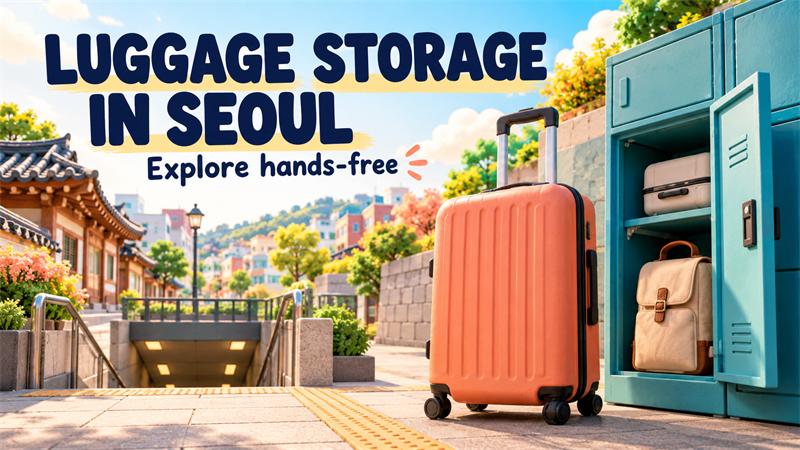
You have checked out of your hotel, but your flight is not until the evening. There is time for lunch, a walk, and one more café. There is also a suitcase that suddenly feels much heavier than it did yesterday.
Dragging it through busy streets and down subway stairs can turn a relaxed afternoon into a logistics problem. Fortunately, you have several options: asking your accommodation to hold it, using a station locker, or leaving it at a staffed storage counter.
The best choice depends on where you are going next. A cheap locker is not especially convenient if you need to cross the city to collect your bag. This guide explains how to choose a practical location, use storage services, and avoid an unpleasant surprise when you return.
1. Start with your accommodation
Before searching for a locker, ask the front desk whether it can hold your bags before check-in or after checkout. Describe your situation clearly: how many bags you have and when you will return.
You can say:
Could you keep these two suitcases until 5 p.m. after checkout? Is there a storage fee?
Do not assume this service is available or free. A staffed hotel and a self-check-in apartment may have very different arrangements. If there is no front desk, contact the host before arrival instead of leaving luggage in a hallway or outside a locked door.
If storage is offered, ask where to collect the bags and whether staff will be there at your return time. Keep any claim ticket you receive. Also consider the return journey: if your hotel is far from your afternoon plans, a storage location along your route may save more time.
2. Choose between a locker, a staffed counter, and delivery
These services solve different problems.
| Option | When it can work well | What to check first |
|---|---|---|
| Accommodation storage | You will return to the same property | Permission, fee, and collection time |
| Self-service locker | You need a few hours and your bag fits | Size, available space, payment, and access hours |
| Staffed storage counter | You want assistance or have a larger bag | Accepted dimensions, opening hours, and total price |
| Luggage delivery | You want your bag moved to another location | Booking deadline, destination, and guaranteed collection arrangements |
In Seoul, T-Locker provides self-service storage, while T-Luggage offers staffed storage and delivery services. They are related travel options, but a locker reservation is not automatically a delivery booking. Use the correct service page for the task you need.
For a simple afternoon outing, ordinary storage may be enough. Delivery becomes useful when it fits your route and timing, rather than simply because it sounds more convenient.
3. Pick the location by your return route
Imagine that you check out in the morning, spend the afternoon around Myeongdong, and then leave Seoul. A storage point near your afternoon stop or onward transport may make sense. A location near a café you visit only once in the morning may be less useful.
Search a map for 물품보관함 for lockers, 짐 보관 for luggage storage, or the service name. Open the individual listing rather than navigating only to the station name.
Large stations can have several floors, exits, and separate locker banks. Save the station name, floor, nearby exit, and locker or counter name. Photographing the surrounding signs can make collection much easier later.
If the storage point is within a paid transport area, check how you will get back to it. You do not want to discover an unexpected access requirement while hurrying to catch a train. Ask station staff when the location is unclear, and leave enough time to find it before committing to a booking.
4. How to use a self-service locker
Follow the instructions on the specific locker. Depending on the installation, you may be directed to a screen, a QR-based web page, or an app. Do not assume a guide written for another locker will match every button you see.
A useful sequence is:
- Find an available compartment that fits your bag, including wheels and handles.
- Read the initial storage period, additional charges, and collection deadline.
- Check that you can use the offered payment and unlocking methods.
- Follow the payment and door-opening instructions shown there.
- Place the bag inside and confirm that the door closes and locks properly.
- Save the locker number, receipt, and retrieval instructions before walking away.
If an app offers availability or reservation information, use it to reduce unnecessary walking, but confirm the exact locker bank and size. T-Locker's service information describes location search and checking available compartments.
Keep your phone with you. If you need it to open the locker, leaving it inside creates an obvious problem. A screenshot of the booking is useful as a record, but it may not replace a live app or web connection required to unlock the door.
5. How to use a staffed luggage counter
A staffed counter can be a comfortable option when you want someone to explain the process. Tell the staff how many bags you have and your expected pickup time. Ask for the total expected charge before paying.
For example:
I have one suitcase. I will return around 6 p.m. How much will the total storage cost be?
Ask whether the bag's size changes the price and whether late collection creates an additional charge. If you reserved online, show the confirmation and check that the location and date are correct.
Keep the receipt or claim reference. Ask whether identification is needed when collecting the bag, especially if someone else in your group will return for it. T-Luggage's terms describe identification checks and restrictions on what can be accepted.
A large bag is not automatically accepted at every counter. Sports equipment, unusually shaped luggage, or several oversized suitcases should be confirmed in advance rather than taken there on the assumption that staff will find space.
6. Read the price and collection time together
The first price you see may cover only an initial period. Extra hours can change the total, and weekday and weekend prices may differ.
As one example, T-Luggage's published price table lists small-bag storage for the first four hours at ₩3,000 on weekdays and ₩4,000 on weekends, with an additional hourly charge shown. This is a provider-specific example, not a standard price for every Seoul locker. Use the current quote for your location, bag, date, and duration.
Collection time matters just as much. A locker inside a station is not necessarily accessible around the clock, and a staffed counter has its own opening hours. Ask: "What is the latest time I can actually retrieve my bag?"
If you plan to return close to closing time, choose an earlier collection target. Leave a buffer for a delayed meal, a wrong subway exit, or a queue at the counter. Paying for storage does not mean the building will remain open for you.
7. Keep essentials and restricted items out of the bag
Before closing your suitcase, take out your passport, wallet, phone, charger, and anything you need before collection. Keep essential medication with you as well.
Check the provider's prohibited-item list. T-Luggage's published terms exclude items including passports, cash, valuable electronics, and certain fragile or perishable goods. Do not assume a service accepts everything just because it fits in a suitcase.
For ordinary travel items, close the bag properly and photograph its exterior before handing it over. Keep the claim information somewhere you can reach without opening the stored bag. If a receipt is digital, make sure you can access the relevant email or reservation page.
These small preparations are especially useful on departure day. Your passport should be with you when you head toward the airport, rather than in a bag that may be delayed or waiting at a different location.
8. Airport delivery needs a separate timetable
Luggage delivery means the bag travels separately from you. Before booking, confirm the drop-off cutoff, the receiving location, and when the bag will actually be available there.
Check the airport terminal as carefully as you check the flight. A reservation for the wrong terminal can create a much larger problem than a slightly inconvenient city storage location.
T-Luggage publishes delivery procedures and separate drop-off and pickup windows. Use the current booking instructions for your route; do not treat the storage counter's closing time as the delivery acceptance deadline.
If you have an early flight, ask whether that service can meet your schedule at all. If the available pickup time is too late, carry your bag yourself or choose another confirmed arrangement. An airport delivery reservation also does not replace airline baggage check-in.
9. Useful phrases and a quick departure check
You can show these phrases on your phone if needed.
| What you want to ask | Korean |
|---|---|
| Can I leave this suitcase here? | 이 캐리어를 맡길 수 있나요? |
| How much is it for four hours? | 네 시간 맡기면 얼마인가요? |
| What time do I need to collect it? | 몇 시까지 찾아야 하나요? |
| Will this suitcase fit? | 이 캐리어가 들어가나요? |
| Where do I collect my bag? | 짐은 어디에서 찾으면 되나요? |
Before leaving, check five things: the bag is secured, you know the exact pickup location, you understand the final collection time, you have the retrieval information, and your passport and phone are with you.
Once that is sorted, save a map pin for the return journey and set a reminder. The point of luggage storage is to make the remaining hours of your trip easier. Choosing a place that fits your route, and collecting your bag comfortably before the deadline, usually matters more than finding the lowest advertised price.
You may also like
You may also like



Related Posts

Korean Hair Salon Phrases: How to Ask for a Haircut You Actually Want
Worried about explaining a haircut in Korean? Short phrases for a Korean hair salon: asking about appointments, confirming the service and total price, using a reference photo, agreeing on length before cutting, speaking up during the wash, and checking the result, plus a practice conversation.

Korean Clothing Store Phrases: Try Things On, Find Your Size, and Ask About Exchanges
Shopping for clothes in Korea? Short Korean phrases for browsing, asking for another size or color, using the fitting room, checking prices and alterations, asking about exchanges and refunds before paying, answering checkout questions, and returning an item for a different size.

Korean Taxi Phrases: Show Your Destination, Ask Questions, and Pay with Confidence
Taking a taxi in Korea without speaking Korean? Short phrases to show your destination, answer the driver's questions, explain luggage and passengers, ask about time and fares, request a safe stop, and confirm payment and receipts, plus a practice conversation.