Korean Clothing Store Phrases: Try Things On, Find Your Size, and Ask About Exchanges
Shopping for clothes in Korea? Short Korean phrases for browsing, asking for another size or color, using the fitting room, checking prices and alterations, asking about exchanges and refunds before paying, answering checkout questions, and returning an item for a different size.
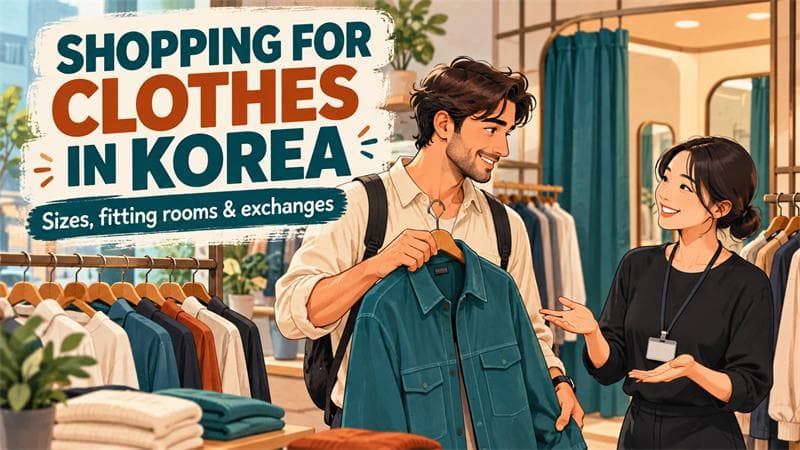
You find a jacket you like in a Korean clothing store. The color is right, the price looks reasonable, and then a staff member asks you something you do not understand. Are they asking about your size? Offering another color? Telling you that you cannot try it on?
Shopping becomes much easier when you recognize a few questions and know how to give a short answer. You do not need to hold a long conversation. Most of the time, you need to explain what you are looking for, check the fit, and understand the conditions before paying.
Here are practical Korean phrases for those moments, including what to say if you want to exchange an item later. Store policies differ, so use the questions to find out the rules at the actual shop you are visiting.
1. Say whether you want help or just want to browse
You may hear 찾으시는 거 있으세요?, meaning “Are you looking for anything in particular?” If you want to browse, 그냥 둘러볼게요 means “I'll just have a look.” It is a polite, ordinary response.
If you want help, one item name is enough to get started.
| Korean | English meaning |
|---|---|
| 셔츠를 찾고 있어요. | I'm looking for a shirt. |
| 바지 좀 보여 주세요. | Could you show me some pants? |
| 이 옷은 어디에 있어요? | Where can I find this item? |
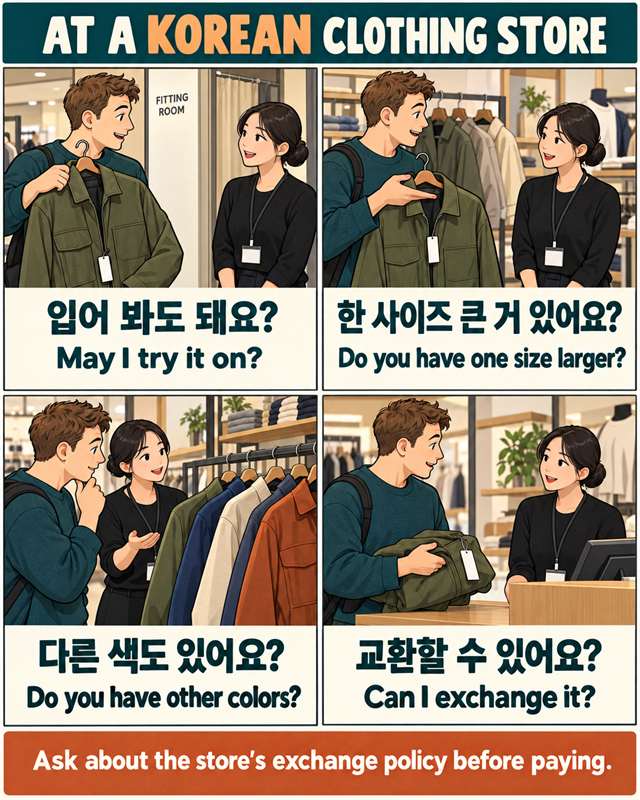
| 다른 색도 있어요? | Do you have other colors? |
| 검은색 있어요? | Do you have it in black? |
If you have a photo from the shop's website, show it when asking about an item. A similar-looking jacket may belong to a different collection or be made from a different material. The product image or item number can make the conversation easier.
You might hear 품절이에요: “It's sold out.” If another branch would be convenient, ask 다른 매장에는 있어요? — “Is it available at another store?” Staff may be able to check, but do not assume every shop has access to other branches' stock.
2. Ask for another size without getting stuck on the label
The most useful phrase is often 한 사이즈 큰 거 있어요? — “Do you have one size larger?” To ask for a smaller one, say 한 사이즈 작은 거 있어요?
| Korean | English meaning |
|---|---|
| 미디엄 사이즈 있어요? | Do you have a medium? |
| 이거보다 큰 사이즈 있어요? | Do you have a larger size than this? |
| 허리가 조금 작아요. | The waist is a little tight/small. |
| 어깨가 조금 좁아요. | The shoulders are a little narrow. |
| 소매가 너무 길어요. | The sleeves are too long. |
You may encounter letters such as S, M, and L, number labels, or 프리 사이즈. The last expression generally means the item is offered in one size; it is not a promise that it fits every body. Actual measurements and the cut of the garment matter more than the label alone.
Rather than relying on a universal conversion, compare the store's size information and try the item on if allowed. For online browsing, check whether a measurement describes the garment laid flat or the circumference. If you cannot tell, ask before treating two numbers as equivalent.
3. Ask before trying an item on
입어 봐도 돼요? means “May I try it on?” It is a useful question even when you can see a fitting room. Some items or stores may have restrictions.
You can then ask 탈의실이 어디예요? — “Where is the fitting room?” The English word “fitting room” may also appear on signs, but 탈의실 is worth recognizing.
| Korean | English meaning |
|---|---|
| 이거 입어 봐도 돼요? | May I try this on? |
| 몇 벌까지 입어 볼 수 있어요? | How many items can I try on? |
| 다른 사이즈로 입어 볼게요. | I'll try another size. |
| 조금 더 생각해 볼게요. | I'll think about it a little more. |
Keep the tags attached and follow the staff's instructions. Trying something on does not mean you have agreed to buy it. If it does not work, you can hand it back and say 사이즈가 안 맞아요 — “The size doesn't fit.”
Before deciding, sit down if practical, move your arms, and check whether the waistband and shoulders feel comfortable. A garment can look fine in the mirror but feel different when you move. You do not need complicated Korean to explain the problem: point to the area and say 여기가 조금 불편해요, meaning “It's a little uncomfortable here.”
4. Check the price and any alteration cost
If you are not sure which price applies, ask 이거 얼마예요? — “How much is this?” For a discounted item, 할인된 가격인가요? means “Is that the discounted price?”
A sale sign may apply only to selected items or require conditions you have not noticed. Ask about the specific garment instead of assuming that a large discount sign covers everything nearby.
If pants fit well except for the length, you can ask 바지 길이 수선도 되나요? — “Can you shorten the pants?” Not every shop offers alterations, and the price or completion time may vary.
| Korean | English meaning |
|---|---|
| 수선비는 따로 있나요? | Is there a separate alteration charge? |
| 언제 찾을 수 있어요? | When can I pick it up? |
| 오늘 받을 수 있어요? | Can I get it today? |
| 전체 금액이 얼마예요? | What is the total price? |
Agree on the finished length before the alteration begins. If you will be leaving the area soon, confirm the collection time too. Also ask how alterations affect exchange or refund options before authorizing the work, rather than discovering the conditions afterward.
5. Ask about exchanges before paying
The two words to remember are 교환, meaning an exchange, and 환불, meaning a refund. They are different requests. A shop's answer about one does not automatically answer the other.
| Korean | English meaning |
|---|---|
| 사이즈가 안 맞으면 교환할 수 있어요? | Can I exchange it if the size doesn't fit? |
| 환불도 가능한가요? | Are refunds also possible? |
| 며칠 안에 가져와야 해요? | Within how many days should I bring it back? |
| 영수증이 필요한가요? | Do I need the receipt? |
| 이 매장으로 가져와야 해요? | Do I need to bring it back to this branch? |
These questions are especially helpful when buying a gift or shopping shortly before a trip. Confirm the conditions for the exact item, including sale items or altered clothing. Do not assume that an in-store purchase follows the same process as an online order.
Keep the receipt and tags, and avoid wearing or washing the item until you have decided to keep it. Those steps can help preserve your options, but they do not by themselves guarantee that an exchange or refund will be accepted.
If the explanation is difficult, ask staff to show you the written policy and use a translation app. 교환 조건을 적어 주실 수 있어요? means “Could you write down the exchange conditions?”
6. Understand a few checkout questions
At checkout, you may be asked 봉투 필요하세요? — “Do you need a bag?” If you do, say 네, 주세요. If not, say 아니요, 괜찮아요. Ask 봉투는 얼마예요? if you want to check whether there is a charge and how much it is.
회원이세요? means “Are you a member?” You can simply say 아니요 if you are not. You do not need to join a membership just to answer the question.
For payment, 카드로 결제할게요 means “I'll pay by card.” If you are unsure whether your card will work, 이 카드로 결제할 수 있어요? means “Can I pay with this card?” Acceptance can depend on the card and payment system, so avoid assuming that every overseas card will work everywhere.
Finally, 영수증 주세요 means “A receipt, please.” Put it somewhere you can find it again, especially if you may need to exchange the item.
7. What to say when returning for an exchange
Bring the item and the purchase information the store requested. Start with what you want to do.
사이즈를 교환하고 싶어요.
I'd like to exchange it for another size.어제 여기서 샀어요. 영수증도 있어요.
I bought it here yesterday. I also have the receipt.한 사이즈 큰 걸로 바꿀 수 있을까요?
Could I exchange it for one size larger?
Only use the details that are true for your purchase. If you bought it online, show the order information and ask where that return or exchange must be handled. A physical shop may not process an online purchase in the way you expect.
If there is a problem with the item, describe it directly: 지퍼가 잘 안 올라가요 means “The zipper doesn't go up properly.” That is more useful than saying only that you dislike it. An item problem and a change of mind can lead to different discussions; this phrase guide does not determine your legal rights or a shop's decision.
8. A short shopping conversation
Staff: 찾으시는 거 있으세요?
Are you looking for anything in particular?
You: 이 셔츠 다른 사이즈 있어요?
Does this shirt come in another size?
You: 한 사이즈 큰 거요. 입어 봐도 돼요?
One size larger. May I try it on?
Staff: 네, 탈의실은 저쪽이에요.
Yes, the fitting room is over there.
You: 이걸로 할게요. 교환은 며칠 안에 해야 해요?
I'll take this one. Within how many days would I need to exchange it?
This is an example conversation; the staff member's answer will depend on the shop. Save the phrases that suit your plans, take a little time to check the fit, and ask about conditions before paying. A small question at the counter can save a much more difficult conversation later.
You may also like
You may also like


Related Posts

Korean Taxi Phrases: Show Your Destination, Ask Questions, and Pay with Confidence
Taking a taxi in Korea without speaking Korean? Short phrases to show your destination, answer the driver's questions, explain luggage and passengers, ask about time and fares, request a safe stop, and confirm payment and receipts, plus a practice conversation.
How to Use a Laundromat in Korea: A Practical Guide for Travelers
Running out of clean clothes on your trip? A step-by-step guide to self-service laundromats in Korea: what to search for, key Korean words on the machines, matching the machine number when you pay, checking whether detergent is automatic, choosing a dryer setting, and what to do if a machine won't start.

Food Delivery in Korea: Can Tourists Order to a Hotel?
Tired after a day of sightseeing and craving Korean fried chicken? A step-by-step guide to ordering food delivery to your hotel in Korea: asking reception first, choosing a service you can actually use, entering the right address, reading menu options, avoiding double payments, and collecting your order.