How to Use a Laundromat in Korea: A Practical Guide for Travelers
Running out of clean clothes on your trip? A step-by-step guide to self-service laundromats in Korea: what to search for, key Korean words on the machines, matching the machine number when you pay, checking whether detergent is automatic, choosing a dryer setting, and what to do if a machine won't start.
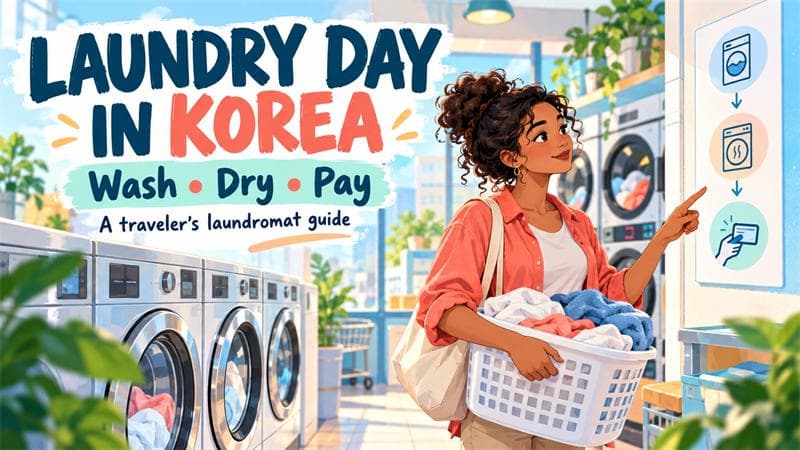
A few days into your trip, you may have plenty of places left to visit but very few clean shirts. Washing everything in the hotel sink does not sound appealing, especially when your clothes might still be damp the next morning.
A self-service laundromat can be useful. The unfamiliar part is working out which machine to use, how to pay, and whether detergent is already included.
There is no single button sequence that works at every Korean laundromat. Follow the instructions on the machine you choose, using this guide to understand the decisions along the way.
1. Find a self-service laundromat, not just a laundry shop
First ask whether your accommodation has guest laundry facilities. A washing machine downstairs may be more convenient than carrying a bag across the neighborhood. Confirm whether there is a dryer, how payment works, and when you can use the room.
If you need a separate shop, search your map app for 셀프빨래방, 코인빨래방, or 코인세탁소. These terms refer to self-service or coin laundry. The broader word 세탁소 can also refer to a staffed cleaning shop where you leave clothes for later collection.
Look at photos to see whether there are machines you operate yourself. Check the exact location and opening hours rather than assuming every laundromat is open all night.
Also look for payment information. The word “coin” in a listing is not enough to tell you whether a particular branch uses coins, a kiosk, a store card, or another system.
2. Bring the right clothes and leave enough time
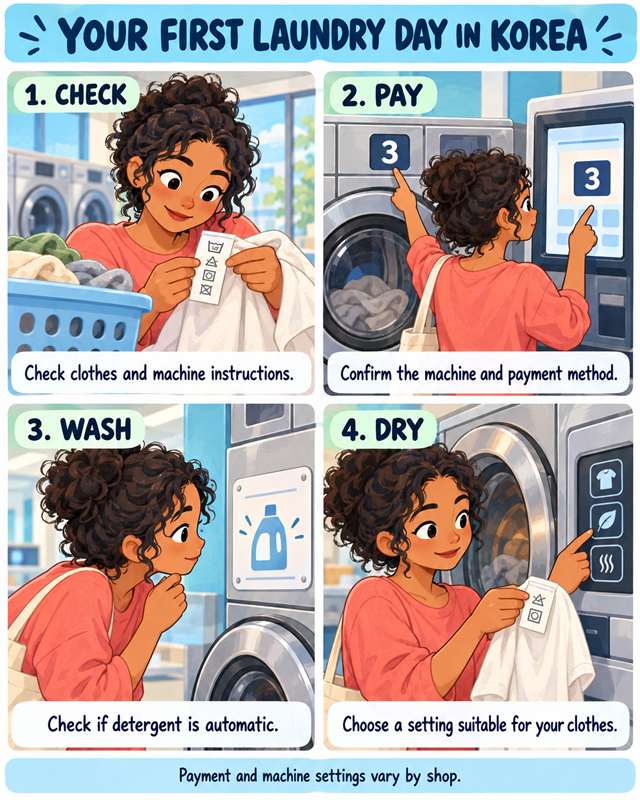
Take a laundry bag and a way to carry the clean clothes back. Empty pockets and check clothing care labels before choosing a wash cycle. Separate items that need different treatment rather than putting everything into the largest machine.
For your first visit, ordinary machine-washable travel clothes are a simpler choice than an expensive coat or a delicate garment. Do not assume that a large commercial washer makes every item suitable for machine washing. Check posted restrictions before using the equipment for shoes, pet items, or unusually dirty articles.
Allow time for washing, transferring clothes, drying, and folding. There may also be a wait for an available machine. The time shown for a wash cycle is not the total time for the visit.
If you need to catch a train or check out soon, leave a comfortable margin. Laundry is an awkward task to rush halfway through.
3. Learn a few words before paying
These labels will help you distinguish the machines and instructions:
| Korean | Meaning |
|---|---|
| 세탁기 | Washing machine |
| 건조기 | Dryer |
| 세탁 | Washing |
| 건조 | Drying |
| 세제 | Detergent |
| 섬유유연제 | Fabric softener |
| 자동 투입 | Dispensed automatically |
| 동전 교환기 | Coin-change machine |
| 시작 | Start |
| 사용 중 | In use |
| 고장 / 사용 금지 | Out of order / Do not use |
| 고온 / 중온 / 저온 | High / Medium / Low temperature |
Take a moment to identify the washer and dryer. A machine with a large round door is not necessarily a washer, and drying may require a separate payment and transfer to another machine.
If you use a translation app, photograph the instructions and the relevant controls together. Translating one isolated button may not explain which step comes first.
4. Check the machine number and payment method
Choose an available machine with enough capacity for your load, following its loading guidance. A bigger drum is not an invitation to pack clothes tightly inside it.
If payment happens at a central kiosk, match the number on the screen to the number on your chosen machine. Paying for the machine next to yours is a frustrating mistake that a quick check can prevent.
Follow the posted sequence for loading, selecting a program, paying, and starting. That order can vary between systems. After payment, check whether you still need to press a start button and whether the machine has actually begun running.
Do not assume every terminal accepts an overseas card. If it does not, check the available alternatives or contact the number posted in the shop. If coins are required, check the accepted denomination before using a change machine.
For a system that uses prepaid credit or a store card, check whether a deposit, minimum top-up, or unused balance applies. Avoid loading more than you need without understanding the terms.
5. Find out whether detergent is included
Before adding anything, check for 세제 자동 투입, meaning detergent is dispensed automatically.
Some laundromat chains advertise automatic detergent and fabric-softener dispensing. That is a feature to look for, not a rule to assume at every laundromat or for every program.
If detergent is already supplied, follow the machine’s instructions rather than adding your own as well. If it is not included, check what product and amount the machine requires. A shop may have a vending machine, but do not rely on that without checking.
These short questions are useful when asking the operator for help:
세제가 자동으로 들어가나요?
Is detergent added automatically?세제를 따로 넣어야 하나요?
Do I need to add detergent separately?
If you need a fragrance-free wash or must avoid a particular product, ask about the available settings before paying. Do not assume automatic dispensing can be switched off.
6. Treat drying as a separate decision
When the wash is finished, follow the machine’s release instructions and move the clothes only after the door unlocks. Do not force a locked door.
Check each item’s care label before placing it in a tumble dryer. Choose a setting that suits the clothes and the dryer’s instructions. The hottest setting is not automatically the best choice simply because you want to leave sooner.
Drying charges may be based on blocks of time, a selected program, or another system. Read the displayed price and duration before adding payment. If more time is needed, follow the instructions for extending the cycle rather than repeatedly pressing unfamiliar buttons.
For a simple budgeting example, if washing costs ₩5,000 and your selected drying cycle costs ₩4,000, the combined cost is ₩9,000 before other purchases or extra drying time. These are illustrative numbers, not a current price quote.
Check that clothes are dry enough before folding them into your bag, especially if you are packing them in a suitcase for several hours.
7. Stay aware of the cycle and shared space
Set a phone reminder based on the machine’s displayed time, and keep track of your machine number. If you step outside briefly, be back when the cycle finishes and follow the shop’s rules about leaving the premises.
Do not leave your passport, wallet, or other valuables with your laundry. Use folding tables for clean clothes rather than as storage for shoes or dirty bags. Return shared baskets after use.
If a machine is occupied by someone else’s finished load, follow the posted policy or contact the operator. Avoid assuming you can move another person’s belongings wherever you like.
Before leaving, check the drum and door area for small items, collect your payment card or change, and take all your belongings. A quick check for a missing sock is easier than a return journey.
8. If something goes wrong, note the machine number
If you have paid but the machine has not started, stop before paying again. Check the displayed message and the normal start instructions. Then contact the operator using the details posted in the shop if you need help.
Have the branch location, machine number, payment time, and amount ready. A photo of the error display or receipt can help explain the issue. Do not include unrelated personal information in screenshots.
You can show or send this sentence:
결제했는데 기계가 작동하지 않아요. 확인 부탁드립니다.
I paid, but the machine is not working. Please check.
An unattended shop does not necessarily mean help is unavailable, but the contact method and response time vary. Do not force a door, open equipment panels, or try to repair the machine yourself.
For your first visit, remember five checks: the right machine, the right payment, detergent instructions, a suitable drying setting, and enough time. Once you have done it once, a laundry stop can become a straightforward part of a longer trip in Korea.
You may also like
You may also like


Related Posts

Korean Hair Salon Phrases: How to Ask for a Haircut You Actually Want
Worried about explaining a haircut in Korean? Short phrases for a Korean hair salon: asking about appointments, confirming the service and total price, using a reference photo, agreeing on length before cutting, speaking up during the wash, and checking the result, plus a practice conversation.

Korean Clothing Store Phrases: Try Things On, Find Your Size, and Ask About Exchanges
Shopping for clothes in Korea? Short Korean phrases for browsing, asking for another size or color, using the fitting room, checking prices and alterations, asking about exchanges and refunds before paying, answering checkout questions, and returning an item for a different size.

Korean Taxi Phrases: Show Your Destination, Ask Questions, and Pay with Confidence
Taking a taxi in Korea without speaking Korean? Short phrases to show your destination, answer the driver's questions, explain luggage and passengers, ask about time and fares, request a safe stop, and confirm payment and receipts, plus a practice conversation.