Taking Out the Trash in Korea: Bags, Recycling Areas, and Food-Waste Cards
You have moved in, finished a meal, and opened a few delivery boxes — now where does it all go? A first-week guide to designated bags, your building's collection area, recycling containers, and the food-waste card.
This article was prepared with AI assistance. Disposal days, bags, and collection methods vary by area and building, so check the instructions where you live.
You have moved into a home in Korea, finished a meal, and opened a few delivery boxes. Now comes a surprisingly confusing question: where does all the rubbish go?
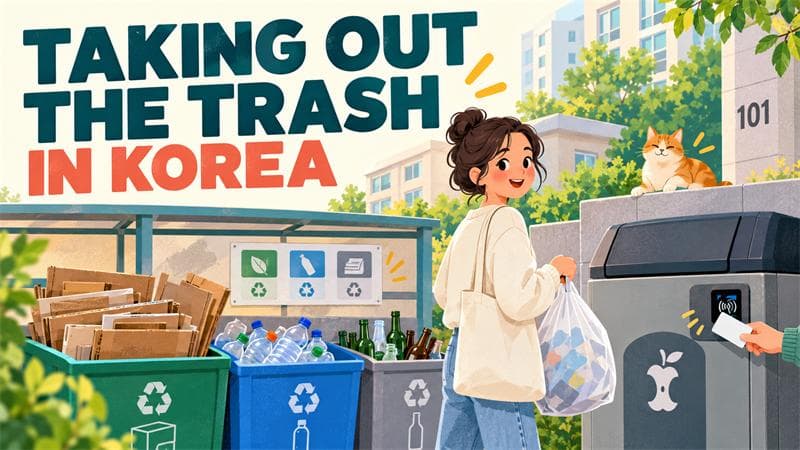
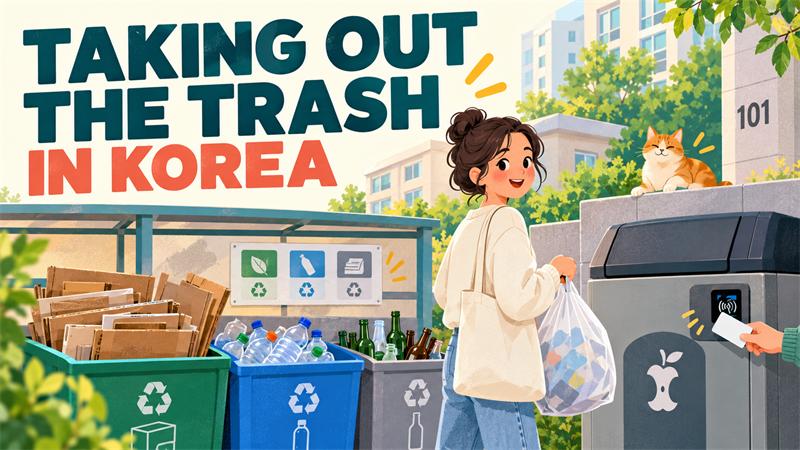
For everyday household rubbish, start with three groups: general waste, recyclables, and food waste. Learn where each one goes at your building, and the routine becomes much easier.
1. Buy the right bags for general waste
For ordinary household waste that is not collected separately, you generally use designated rubbish bags. Look for them at a nearby convenience store, supermarket, or other authorized seller. You may need to ask the cashier because the bags are sometimes kept behind the counter.
Tell the shop which kind and size you want—for example, a 10-litre general-waste bag. Buy bags accepted in the area where you live. An ordinary shopping bag is not a replacement. Local disposal guide example
For your first purchase, ask your landlord or building manager to show you the correct bag. A photo makes it easy to buy the same kind next time.
If you are unsure how to ask at the shop, show the photo and point to the size you want. Start with a small pack rather than buying a large supply immediately. After using it for a few days, you will have a better idea of what size suits your household. Keep the spare bags together so you can easily tell the general-waste bags from any food-waste bags.
2. Find your building's disposal area
Ask this as soon as you move in:
"Where should I put general waste, recycling, and food waste? Are there specific days or times?"
An apartment building may have a shared collection area. A smaller rental building may use another designated spot. Use the location assigned to your home; do not leave household rubbish in a street bin or at another building.
Some places allow residents to bring recycling out daily, while others set particular days. The building's drop-off arrangements and the collection truck's schedule are not necessarily the same. A quick look at the sign—or one question to the manager—can save you a wasted trip downstairs.
When someone shows you the collection area, ask them to point out each spot rather than simply saying "over there." Take your own note or a photo of the signs. If you share a home, tell your housemates what you learned and agree on who takes things out. A reminder on the refrigerator can help when recycling is only accepted on particular days.
3. Take recyclables to the matching containers
A recycling area may have separate places for paper, plastic containers, bottles, cans, and plastic film. Follow the labels at your building.
Empty leftover food or drink from containers. Rinse away food residue where needed. Flatten cardboard boxes and remove packing tape where practical. If clear drink bottles have their own container, keep them separate and follow the instructions for their labels and caps.
Do not leave an entire mixed bag beside the containers and expect someone else to sort it. Separate the items at home first; it is much easier when you arrive downstairs. For unfamiliar packaging, check the local sorting instructions. Sorting guide example
4. Your food-waste bin may need a card
Some apartment buildings use a food-waste machine that opens with a resident card. If yours does, ask the manager or landlord where to get the card and how to use it.
Typically, you tap the card, put in the food scraps, and close the lid as instructed. The machine may weigh what you throw away and use that amount to calculate the charge. Ask how the charge is paid at your building.
Other homes use designated food-waste bags or a different shared container. Not everyone needs a card. Before buying bags, check which system your home uses.
Drain excess liquid from food scraps and keep plastic packaging out. Chicken bones, shellfish shells, and eggshells are common examples of things that do not belong in food-waste collection; check the local list for anything uncertain. Food-waste guide example
For your first visit to the machine, ask someone to demonstrate it before bringing a full container downstairs. Keep the card somewhere easy to remember, such as beside the door, and check that you have it before leaving home. If the machine does not open, ask the manager for help rather than leaving food scraps beside it. You can use the same conversation to ask what to do if you lose the card.
5. Make your first week simple
Keep one general-waste bag, a place for recyclables, and a small lidded container for food scraps at home. Save a photo of the collection-area notice on your phone.
If the notice is only in Korean, a translation app or AI can help you read it. Ask the manager to confirm any unclear day, time, or item.
Keep your sorting area easy to clean and leave enough space to reach each container. In a small room, even one box for dry recyclables can help prevent a pile of mixed rubbish from building up. Empty it as part of a regular routine that fits your building's disposal times.
You do not need to learn every recycling rule in Korea. Start with the bags your home uses, the place you take them, and whether you need a food-waste card. Once you have done it a few times, it becomes an ordinary part of the week.
You may also like
You may also like


Related Posts

Korean Hair Salon Phrases: How to Ask for a Haircut You Actually Want
Worried about explaining a haircut in Korean? Short phrases for a Korean hair salon: asking about appointments, confirming the service and total price, using a reference photo, agreeing on length before cutting, speaking up during the wash, and checking the result, plus a practice conversation.

Korean Clothing Store Phrases: Try Things On, Find Your Size, and Ask About Exchanges
Shopping for clothes in Korea? Short Korean phrases for browsing, asking for another size or color, using the fitting room, checking prices and alterations, asking about exchanges and refunds before paying, answering checkout questions, and returning an item for a different size.

Korean Taxi Phrases: Show Your Destination, Ask Questions, and Pay with Confidence
Taking a taxi in Korea without speaking Korean? Short phrases to show your destination, answer the driver's questions, explain luggage and passengers, ask about time and fares, request a safe stop, and confirm payment and receipts, plus a practice conversation.