Your First 30 Days in Korea: The Essential Admin Checklist for International Students
A chronological 30-day admin checklist for international students arriving in Korea — ARC, bank account, mobile phone, dorm, classes. Avoid the pitfalls that stall an entire semester.
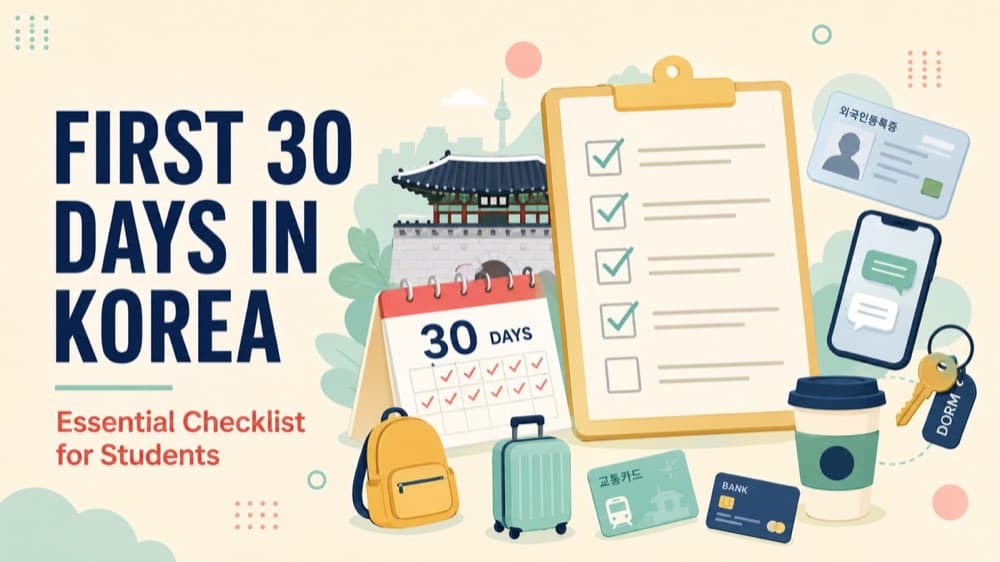
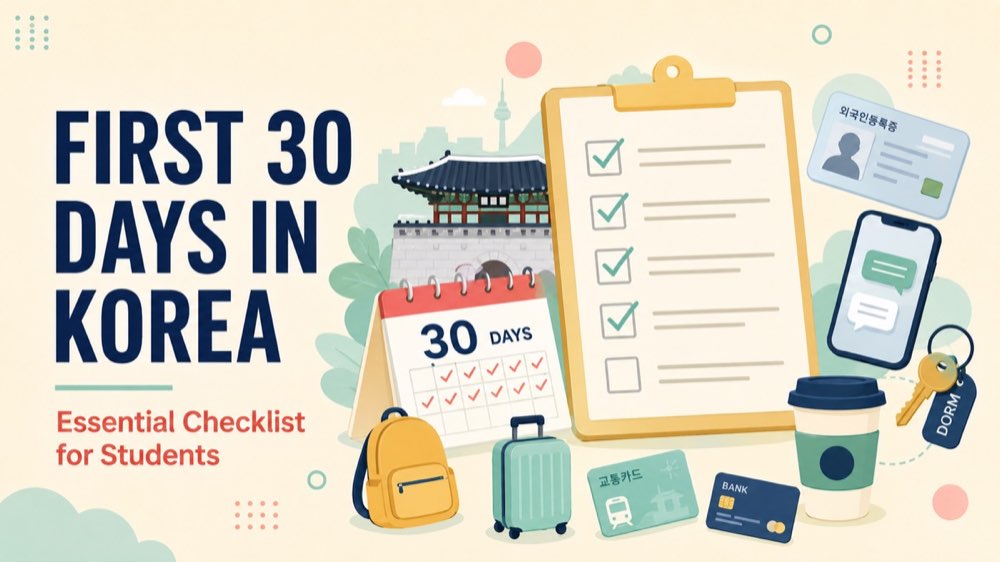
You got the visa, boarded the plane, and arrived in Korea. But this isn't the end.
The first 30 days after arrival are when the real administrative battle begins. Alien Registration Card, bank account, mobile phone, health insurance, dorm move-in, course registration — the to-do list is mountainous. The students the admin office helps most often are the new arrivals who come in saying, "I've been here a week and haven't been able to do anything."
Korea's administrative system is efficient, but it operates on strong sequential dependencies. You need an ARC to open a bank account, a bank account to set up a mobile phone contract, a phone to authenticate KakaoTalk, and so on. When one step gets stuck, everything after it stops too.
This article is a chronological checklist of the administrative tasks you must complete within the first 30 days.
Pre-Departure Preparation (1–2 weeks before leaving)
The first few days after arrival are chaotic with jet lag and administrative tasks. Preparing in advance makes everything much smoother.
Essential items:
- Passport (valid 6+ months)
- D-2 visa
- 3–5 copies of your Certificate of Admission
- Copy of your final education graduation certificate
- 5–10 passport photos (it's inconvenient to take them in Korea)
- Medical prescriptions (if you take regular medications)
- Internationally usable credit/debit card (some)
- Cash (USD 1,000–2,000 for exchange after arrival)
- School emergency contacts
- Temporary lodging reservation confirmation
Digital preparation:
- Activate your school email account
- Download KakaoTalk (works without a Korean number)
- Install Google Translate and Papago
- Download KakaoMap and Naver Map (Google Maps is unreliable in Korea)
- Currency converter and time zone apps
Day 1–3: Right After Arrival
Airport arrival and transportation
Most international students arrive at Incheon International Airport (ICN) or Gimhae International Airport (PUS). Some schools (especially in the Honam region) are accessible from Gwangju Airport (KWJ).
Options for getting from the airport to your school:
- Airport bus/limousine: Most common. Incheon → major Seoul areas about 16,000 KRW, 90–120 minutes
- Airport Railroad Express (AREX): Direct to Seoul Station for 9,500 KRW
- KTX (high-speed rail): Incheon Airport → regional cities like Busan. Expensive but fast.
- Taxi: Expensive (Incheon → Seoul about 70,000–90,000 KRW)
- School pickup service: Some universities offer this as part of new student welcome events (advance registration required)
First-day tasks:
- Exchange a small amount of currency (airport rates aren't great — do just 30,000–50,000 KRW)
- Get a temporary SIM (SK/KT booths on Airport Floor 1, about 30,000–50,000 KRW)
- Travel to your school or temporary lodging
- Contact your family and school upon arrival
Securing temporary lodging (before dorm move-in)
If your dorm move-in is several days away, consider these options:
- Guesthouses: 30,000–50,000 KRW per night, internationally friendly
- Airbnb: Short-term rentals near your school
- Hotels: Business hotels are 70,000–120,000 KRW per night
- Motels: Cheaper, but international-friendliness varies
Buying basic necessities
- Daiso: All household items 1,000–5,000 KRW — highly recommended
- E-mart, Homeplus: Groceries and bulk household items
- Olive Young: Cosmetics, hygiene items
- Convenience stores (CU, GS25, 7-Eleven): 24/7, emergency food
Basic items needed for dorm move-in:
- Bedding (most dorms provide only the mattress)
- Pillow, blanket, sheets
- Toiletries (towels, toothbrush, toothpaste, shampoo, etc.)
- Power strip (Korea uses 220V — your plugs may not match)
- Indoor slippers
- Hangers
- Basic cooking tools (if individual cooking is allowed)
Day 1–7: School Registration
1. Visit the international office
The first thing to do upon arrival is visit your school's International Office. Email them your arrival schedule in advance so the staff can prepare.
What gets handled at the international office:
- Confirming your registration
- Orientation schedule
- Receiving dorm key
- Emergency contacts
- Student ID issuance information
- Visa management guide
- International student handbook
2. Student ID issuance
Student IDs at most universities are used for:
- Library access
- Classroom/lab access
- Cafeteria payment
- Campus facility access
- Some schools issue a combined student ID + debit card
- Some schools include transit card functionality
Photo registration is often required for student ID issuance.
3. Course registration
Often already closed by your arrival, but some schools run separate course registration windows for international students. Contact your department office immediately.
Course registration considerations:
- English-language courses fill up fast due to popularity
- Choose Korean-language courses carefully based on your level
- Use Korean language support classes for international students
- Don't overload your first semester (12–15 credits is appropriate)
4. Attend orientation
International student orientation is mandatory. Administrative procedures, facility tours, and life-in-Korea tips are all covered. It's also your first chance to meet other international students.
5. Visit your department office
Visit your department office to introduce yourself to the department chair or international student advisor. You'll need their help with academics, career planning, visa renewal, and more in the future.
Day 7–14: Alien Registration Card (ARC) Application
Why ARC matters
The ARC is the foreigner's ID in Korea. Without it, almost none of these are possible:
- Opening a bank account
- Long-term mobile phone contracts
- Health insurance
- Some real estate contracts
- Government administrative procedures
- Some online services (certain shopping sites)
- ID verification at medical facilities
Application process
- Pre-book on HiKorea website: www.hikorea.go.kr
- Korean/English supported
- Available appointments fill up extremely fast — book immediately upon arrival
- Visit the immigration office in your school's district
- Seoul: multiple offices in Yangcheon, Sejongno, Yeongdeungpo, etc.
- Regions: 1–2 in each metropolitan area
- Submit required documents
- Application form (filled out on-site)
- Passport
- Certificate of Admission or enrollment certificate
- Photo (3.5×4.5cm)
- Fee (about 30,000 KRW, cash)
- Proof of residence (dorm move-in confirmation or lease agreement)
- ARC issued in approximately 2–4 weeks: Pickup in person or by registered mail
Admin office tip: Immigration office appointments are extremely competitive. Book on HiKorea immediately upon arrival. Some school admin offices offer group bookings.
First Semester Academic Adaptation Strategies
Academic adjustment is just as important as administrative tasks. Here are common mistakes international students make in their first semester.
1. Adjusting your course load
Korean undergraduate programs typically run 12–18 credits per semester. For your first semester, 12–15 credits is recommended. Why:
- You need time to adjust to Korean lecture style
- Korean-language courses are 2–3x more burdensome at the same credit value
- Group projects with Korean students consume significant time
- Non-academic burdens (admin, dorm adjustment) are heavy
Among international students who take 18+ credits in their first semester, more than 70% see their GPA drop. Don't be greedy — start with an appropriate load.
2. Course selection criteria
Even on the English track, taking 1–2 basic Korean courses is recommended. The school's regular Korean language program is the most systematic. Korean culture/history electives also help with adaptation.
Courses to avoid:
- Courses where attendance counts for more than half the grade
- Korean-language courses with heavy presentation components (difficult below TOPIK Level 4)
- Courses with Korean-language essay-based finals
3. Building relationships with professors
Send an introduction email after your first class. Letting your professor know you're an international student and might need help is usually well-received — most Korean professors are happy to support you. Requesting a pre-exam meeting often gets you more detailed explanation of exam format and key content.
4. Collaborating with Korean students
Group projects are unavoidable. Approach them as follows:
- Volunteer for roles where you can contribute (data analysis, research, English source translation)
- Attend all meetings (sit in even if you can't speak Korean well)
- Express opinions actively in KakaoTalk groups (translation tools are fine)
- Thank your team after the project (build connections with Korean students)
5. Using academic resources
Korean universities have many support resources for international students:
- Learning Support Centers (Writing Center, Tutoring)
- International student mentoring programs (matched with a Korean mentor)
- International student-only study spaces in libraries
- Department-specific office hours for international students
Many students don't know about these resources and struggle alone. In your first week, get a list of available resources from the school website or international office.
Day 14–21: Communications and Banking
1. Mobile phone setup
Three options:
Option A: Prepaid SIM
- Possible without ARC
- For short-term or temporary use
- 1–3 month packages: about 30,000–70,000 KRW
- Recommended: SK Prepaid, KT M Mobile
Option B: MVNO (budget carrier)
- Cheap (15,000–30,000 KRW per month)
- International signup can be tricky
- ARC required
- Recommended: KT M Mobile, Hello Mobile, U+ Budget Mobile
Option C: Major carrier contract (SKT, KT, LG U+)
- ARC required
- Device discounts with 24–36 month contracts
- 30,000–80,000 KRW per month
- International student plans available
Common pattern: Start with a prepaid SIM → switch to MVNO or major carrier contract after ARC issuance.
2. Opening a bank account
Possible after ARC issuance. On-campus bank branches are most convenient (they have experience with international students).
Recommended banks:
- KB Kookmin Bank: Most international transactions, strong English service
- Shinhan Bank: Often issues combined student ID + debit cards
- Woori Bank: Many on-campus branches
- Hana Bank: Strong international remittance
- KakaoBank/Toss Bank: Internet banks, gradually expanding international access
Required documents:
- Passport
- ARC
- Student ID or enrollment certificate
- Korean phone number (required)
- Personal seal (optional — signatures work)
- Initial deposit (even 1,000 KRW works)
3. KakaoTalk, Toss, KakaoPay
Daily life in Korea is essentially impossible without KakaoTalk. Department group chats, communication with professors, friendships — all happen on KakaoTalk. Apps like Toss and KakaoPay for instant transfers are equally essential.
Sign-up order:
- KakaoTalk (verified with Korean number)
- KakaoPay (linked to KakaoTalk)
- Toss (separate app, strong for transfers)
Practical uses:
- Splitting bills with classmates → transfer via Toss/KakaoPay
- Restaurant/cafe payment → KakaoPay/NaverPay
- Department announcements → KakaoTalk group chat
- Questions to professors → email or KakaoTalk
Day 21–30: Health Insurance and Final Setup
1. National Health Insurance enrollment
Since 2024, international students are automatically enrolled in National Health Insurance 6 months after arrival (mandatory). Before that 6-month mark, you'll need school group insurance or private insurance.
Options:
- School group insurance: Group enrollment by the school, typically 50,000–100,000 KRW per semester
- Private medical insurance: Individual enrollment, various student packages
- National Health Insurance: Automatic after 6 months, about 70,000–80,000 KRW per month (student discount)
Medical care tips:
- Mild symptoms: get over-the-counter meds at a pharmacy (most pharmacists can communicate in basic English)
- Need a doctor: Campus health center → local clinic → general hospital
- Emergencies: 119 (ambulance) and contact campus security simultaneously
- Identify English-friendly hospitals in advance
2. T-money transit card
Available at subway stations and convenience stores. Mobile T-money via your phone or transit functions added to credit/debit cards also work.
Options:
- Standard T-money card: 4,000 KRW + top-ups, available at convenience stores/subway stations
- Mobile T-money: Uses phone NFC, integrates with KakaoPay/NaverPay
- Postpaid transit card: Transit functions added to a credit/debit card
Public transit tips:
- Free transfer between subway lines within 30 minutes
- Bus-subway transfers also free
- Apply for a separate student discount card (cost savings)
- Use KakaoMap/Naver Map for route searches (Google Maps is inaccurate)
3. Adapting to life in Korea
Once admin is done, real life in Korea begins.
Highly recommended activities:
- Department events: MT (membership training), clubs, study groups
- International student gatherings: Events organized by the international office
- Language exchange: Korean + your native language
- Making Korean friends: Group projects, clubs, volunteer work
- Cultural experiences: Museums, traditional culture, regional travel
- Learning through K-content: Dramas, variety shows, music, films
30-Day Administrative Checklist Summary
Verify the following items are complete within 30 days:
Week 1 (immediately after arrival)
- International office registration
- Orientation attendance
- Student ID receipt
- Course registration
- Dorm move-in or housing secured
- Temporary SIM purchased
Week 2
- ARC application submitted
- Department office introduction
- Campus facilities familiarized
- Korean phone number secured (even prepaid)
Week 3
- Bank account opened
- Mobile phone contract or MVNO transitioned
- KakaoTalk and Toss signed up
- School group insurance verified
- T-money card obtained
Week 4
- ARC received
- Department club joined
- Korean friends started
- Regular grocery shopping routine established
- Emergency contacts organized
Common Pitfalls and How to Avoid Them
Pitfall 1: Delaying ARC application blocks everything
Without an ARC, bank accounts, phone contracts, health insurance — almost everything stalls. Apply immediately upon arrival.
Pitfall 2: Taking too many courses your first semester
Adjusting to a new environment, language, and system while taking too heavy a load makes every grade suffer. 12–15 credits is the sweet spot.
Pitfall 3: Sticking only with international students
It's comfortable, but your Korean won't improve and your social adaptation will lag. Make a conscious effort to engage with Korean students.
Pitfall 4: Trying to handle administrative procedures alone
The school admin office, international office, and department office exist to help you. Use them actively.
Pitfall 5: Ignoring homesickness
Loneliness and homesickness are natural reactions to a new environment. Make use of school counseling centers, religious communities, international student groups, and the like. Most schools have English-speaking counselors.
Frequently Asked Questions
Q: Are there banks where I can open an account before getting an ARC?
Some banks (Woori Bank, KEB Hana Bank) allow temporary account opening with just a passport. Officially convert after ARC issuance.
Q: How do I work part-time on a student visa?
TOPIK Level 2+ minimum, plus "non-status activity permission" from the immigration office, plus a school recommendation letter. Many universities require waiting 6 months after arrival.
Q: KakaoTalk verification isn't working — what do I do?
KakaoTalk only verifies via Korean phone numbers. Get a Korean number first, even with a prepaid SIM.
Q: What visa do my parents need to visit Korea?
It depends on your visa and your parents' nationality. Generally, short-term visit (C-3) visa or visa-free entry is possible.
Q: Can I move from the dorm to off-campus housing if I don't like it?
Yes. You can move mid-semester, but consider deposit and broker fees. Update your ARC address afterward.
Q: When do I need to extend my visa after arrival?
D-2 visas are typically issued in 1–2 year increments. If your study period is longer, apply for an extension in Korea before expiration. Contact the school admin office before the end of the semester.
Q: Can my family stay with me when they visit Korea?
Dorms don't allow non-resident overnight stays. For family visits, use guesthouses, hotels, or Airbnb near the school. Some schools offer guest rooms specifically for international student families.
Q: What do I do if I lose my ARC?
Report it to the nearest immigration office immediately and apply for reissuance. Takes about 1–2 weeks. Use your passport as ID during the interim.
Q: Can I get a Korean driver's license?
If you have a license from your home country and meet certain conditions (varies by country), you can exchange it for a Korean license. Otherwise, you'll need to retake the test at the Korea Road Traffic Authority.
Q: Where can I eat cheaply besides the school cafeteria?
Restaurants near campus, convenience store lunch boxes, kimbap shops (Kimbap Cheonguk, Kimbap Nara), and bunsik (snack) shops are cheapest. School cafeterias usually run 4,000–6,000 KRW; outside restaurants 7,000–10,000 KRW. Cooking with grocery store ingredients is most economical.
Q: How do I spend my first Korean holiday (Lunar New Year, Chuseok)?
During holiday periods (3–7 days), most Korean students go home. International students often stay on campus or get invited to a Korean friend's family. Many international offices organize holiday events for international students — check in advance.
Q: Where should I visit on weekends in Korea?
In Seoul: Gyeongbokgung Palace, Han River parks, Hongdae, Myeongdong, Insadong. Near Seoul: Ganghwa Island, Pocheon, Gapyeong. In other regions, ask your school's international office for recommendations near campus.
Final Thoughts
Korea's administrative system is efficient but values formal correctness. Missing a single document or stamp often means starting over.
The best strategy is to actively use your school's admin office and international office. Korean university administrative staff are experienced with international students and can usually communicate in English or other languages. Knocking on the admin office door is faster than struggling alone.
Speaking from admin office experience, Korean staff respond very kindly when international students politely ask for help. Even one Korean phrase — "안녕하세요, 도와주셔서 감사합니다" (Hello, thank you for your help) — completely changes the atmosphere. Don't be afraid — ask immediately when you don't understand something.
The first 30 days in Korea are chaotic and difficult, but once that period ends, real student life begins. Students who navigate this period successfully are the ones who go on to complete their Korean study abroad successfully. Wishing you the best for your time in Korea.
You may also like
You may also like

Related Posts
Who Should You Contact at a Korean University? A Guide to Campus Offices
"Please contact another office." Finding the right person at a Korean university can feel like an extra assignment. Here is how to identify the responsible office, write a message that gets answered, and keep the conversation moving when you are redirected.

Using AI to Understand Korean University Notices: What to Double-Check
AI can translate a Korean university notice in seconds — and make an uncertain interpretation sound settled. Here is how to let AI organize the notice while keeping the original as the reference, plus a reusable prompt and a verification checklist.

An HWP or HWPX File Won't Open? Here's What to Do in Korea
Your school sends a form and it will not open — the filename ends in HWP or HWPX. What it is, when a free viewer is enough, when to ask your school first, and how to avoid buying software you may not need.