TOPIK Scores and Korean University Admissions: How They Actually Get Evaluated
How TOPIK scores really get used in Korean university admissions, scholarships, and post-enrollment life — written from inside a Korean university admin office, not from generic guides.
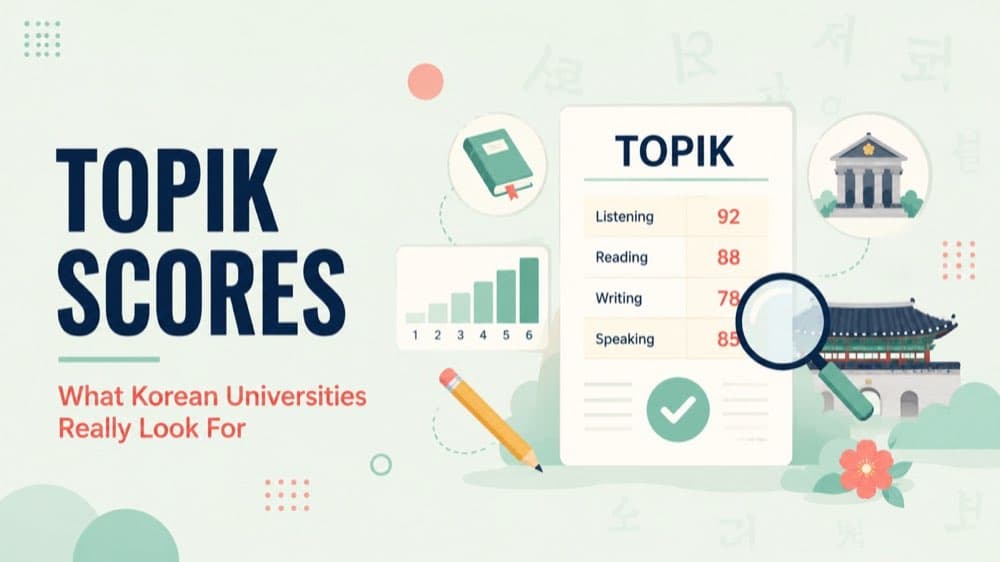
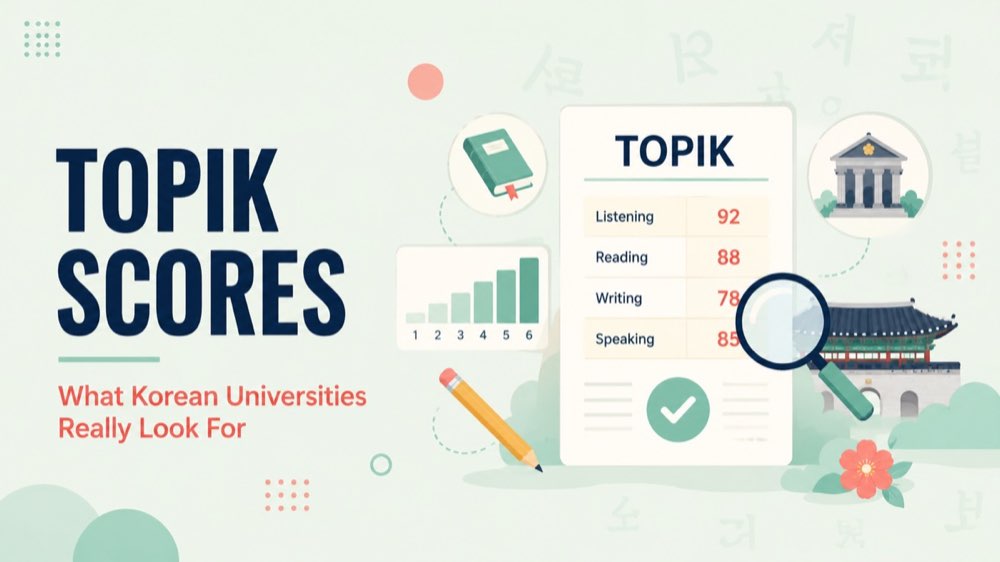
"What TOPIK level do I need to get into a Korean university?" is one of the most common questions international students ask. The internet is full of answers like "at least Level 3" or "Level 4 depending on your major," but few articles actually explain how that score gets used during admissions review.
This guide is based on hands-on experience processing application documents in a Korean university administrative office. It covers how TOPIK scores actually influence acceptance and rejection — not the generic answers you'll find online, but what really happens on the admin desk.
Let me give you the bottom line up front: TOPIK scores are not a simple pass-or-fail cutoff. They get used at multiple stages of the admissions process with different weights, and they continue to affect your experience after enrollment — academic adaptation, scholarship eligibility, department placement, even dormitory roommate matching. By the end of this article, you'll see why "what TOPIK level do I need?" is itself an incomplete question.
TOPIK Basics
TOPIK is the official Korean language proficiency test administered by NIIED.
TOPIK I (Levels 1–2, Beginner)
- 200 points total
- Listening and Reading sections
- Tests everyday Korean
TOPIK II (Levels 3–6, Intermediate to Advanced)
- 300 points total
- Listening, Reading, and Writing sections
- Tests academic and professional Korean
Each year over 330,000 candidates worldwide take the test, and that number is expected to surpass 400,000 in 2026. The test is administered in over 70 countries. Since 2024, an Internet-Based Test (IBT) has been introduced in some regions, expanding testing opportunities.
Official Requirements vs. Actual Admission Cutoffs
This is the most important section. The scores listed in official admission requirements often differ from the actual cutoffs in practice.
Seoul National University (SNU)
- Official requirement: TOPIK Level 3+ (Level 4 for humanities/social sciences)
- Actual cutoff: Levels 5–6 for humanities/social sciences, with Level 4+ preferred even in natural sciences and engineering
- Korean Studies, Korean Language, and Korean History departments effectively require Level 5+
Yonsei University, Korea University
- Official requirement: TOPIK Level 3 (English-track programs like Underwood International College have separate requirements)
- Actual cutoff: Level 4 for typical departments, Level 5 for popular ones (business, media, political science)
- English tracks waive TOPIK but require strong IELTS/TOEFL scores
KAIST, POSTECH (Engineering)
- Official requirement: English track waives TOPIK
- Reality: Some courses are taught in Korean, and there are many collaborative projects with Korean students. TOPIK Level 3+ is practically necessary.
- Korean ability is a major asset for administrative tasks like course registration and lab work.
Mid-tier comprehensive universities (Sungkyunkwan, Hanyang, Kyung Hee, Chung-Ang, HUFS, etc.)
- Official requirement: TOPIK Level 3
- Reality: Level 3 is truly the minimum, and Level 4 is the de facto baseline for admission
- Universities with high international student populations experience score inflation
Regional flagship national universities (Pusan, Kyungpook, Chonnam, Chungnam, etc.)
- Official requirement: TOPIK Level 3
- Actual cutoff: Level 3 is accepted; these universities are actively recruiting international students
- Lower tuition and living costs make these excellent value
Regional private universities
- Official requirement: TOPIK Level 2–3
- Reality: Many accept Level 2
- Generous scholarships available to attract international students
How TOPIK Scores Are Weighted in Admissions
Many students misunderstand this part. TOPIK scores aren't only used as a pass/fail threshold — they affect multiple stages:
1. First Administrative Review (Document Verification)
If you don't meet the official requirement, you're immediately sorted into the rejection pile. This filtering happens at the admin office before the file ever reaches the admissions committee. Students rejected at this stage often never find out why.
To be honest about how this works in practice: during peak season with hundreds of applications, the first review functions almost like an automated checklist. If your language scores, academic credentials, or required documents are incomplete, there's no time to look further. You have to clear this automatic filter before any real evaluation begins.
2. Second Review: Academic Fit Assessment
Even if you meet the official requirement, if your score is on the low end, your study plan and recommendation letters are evaluated to see whether they can compensate. At this stage, having a clear plan for how you'll improve your insufficient Korean ability becomes important.
For example, specific commitments like "I will spend 10+ hours per week in self-study at the library" or "I plan to participate in a language exchange program with Korean students" can help offset slightly lower scores.
3. Department Placement
At universities that allow multiple major preferences, TOPIK scores affect first-choice versus second-choice placement. If your first-choice major is Korean-language-heavy and your score is judged insufficient, you may be placed in your second choice.
4. Scholarship Determination
Internal university scholarships weight TOPIK scores heavily. Even when admitted to the same department, a Level 5 holder is far more likely to receive a scholarship than a Level 3 holder.
University-internal scholarships beyond GKS are commonly tiered by TOPIK level:
- TOPIK Level 6: 100% tuition waiver
- TOPIK Level 5: 70–80% tuition waiver
- TOPIK Level 4: 50% tuition waiver
- TOPIK Level 3: 30% tuition waiver
Specifics vary by university, but this kind of tiered structure is typical.
5. Priority Dormitory Assignment
Some universities consider TOPIK scores when assigning dorms — specifically when matching international students with Korean roommates, since communication ability matters.
Five Common Misconceptions About TOPIK Preparation
Misconception 1: "TOPIK Level 3 is enough"
You may get admitted, but keeping up academically is extremely difficult. Group projects, presentation classes, and department events all suffer when you can't communicate well. Grades drop, and continuing studies becomes hard. From the admin office, the most common pattern among students who take a leave of absence or drop out within their first two semesters is insufficient Korean communication ability.
Misconception 2: "I don't need Korean if I'm in an English-track program"
Even with English-language classes, administrative processes — course registration, visiting the department office, visa renewal, accessing medical services — happen in Korean. The students the admin office most frequently encounters are English-track students who can't access their own rights because they don't speak Korean.
Course registration systems are typically in Korean, and many academic announcements are issued in Korean. Even when English summaries are available, the critical details often have to be checked in the original Korean.
Misconception 3: "Just having a high TOPIK score is all that matters"
The score is just an entry ticket. Actual conversational ability and test scores can differ significantly, and post-enrollment adaptation depends much more on conversation skills. There are surprisingly many TOPIK Level 5 holders whose speaking is weak.
Misconception 4: "Taking TOPIK in Korea is easier"
Taking TOPIK in Korea doesn't automatically yield higher scores. The test is standardized, and Korean test centers can actually be more competitive. Preparing thoroughly in your home country and taking it there is the most efficient approach.
Misconception 5: "TOPIK is only offered twice a year"
That used to be true, but with PBT (paper-based test) offered six times per year and additional IBT sessions, opportunities have multiplied. You can attempt the test multiple times around your own schedule.
Recommended TOPIK Levels by Major
These are the practical levels that allow you to actually succeed academically — not the official minimums, but what you really need:
- Natural sciences/Engineering (English track): Level 3+ (for daily life and admin)
- Natural sciences/Engineering (Korean track): Level 4+
- Business/Economics: Level 4+
- Engineering with industry-academia track: Level 4+ (Korean essential for company collaboration)
- Humanities/Social sciences: Level 5+ strongly recommended
- Korean Literature, Korean History, Korean Studies: Level 6 effectively required
- Law, Medicine, Pharmacy: Level 6 (specialized terminology)
- Arts/Athletics (practice-based): Level 3–4 acceptable
- Journalism/Media: Level 5+
How Korean Ability Plays Out After Enrollment
Based on observing how international students progress from year 1 to year 4, here's what actual adaptation looks like at each Korean ability level.
TOPIK Level 3 equivalent
Basic life is manageable, but academics are very difficult. Korean-language lecture comprehension hovers around 50–60%, leading to test disadvantages. Korean students often find collaboration with such students burdensome, which can isolate them from group work. Administrative tasks almost always require school assistance. First-semester GPA frequently drops below B–.
TOPIK Level 4 equivalent
Basic academics are workable. Lecture comprehension reaches 70–80%. Daily conversation with Korean students is fine, though deep discussion is challenging. Administrative tasks can be handled independently with effort. Average grades around B are achievable.
TOPIK Level 5 equivalent
Academic life truly opens up. Lecture comprehension exceeds 90%. Deep engagement with Korean students becomes possible. Presentation classes are manageable without major stress. Grades comparable to Korean students become achievable, putting you in the upper tier among international students.
TOPIK Level 6 equivalent
Almost identical academic experience to Korean students. Major presentations and graduation theses can be written in Korean. Major advantage when applying for Korean company internships or jobs. Even the admin office responds to you almost as if you were a Korean student.
This is why the admin office recommends "one level above the official requirement." The same four-year degree program produces dramatically different experiences depending on your Korean level.
Effective TOPIK Preparation Strategies
Based on conversations with students who've succeeded, here are some effective preparation methods:
Starting 6 months ahead (targeting Level 3)
- 1 hour of vocabulary daily
- One past exam set per week
- Korean dramas/variety shows with subtitles
Starting 1 year ahead (targeting Level 4–5)
- Korean academy or formal class enrollment
- 2 hours of comprehensive study daily
- Korean journaling (for the writing section)
- Korean podcasts and news
Short-term study abroad
- 2–6 month programs at Korean university language institutes during vacation
- Pass rates significantly higher than self-study
- Cost: about 1.5–2 million KRW per term
TOPIK Test Day Tips
- Listening: Focus from the first question. Don't dwell on missed questions — move on.
- Reading: Time management is critical. Mark difficult passages and return to them at the end.
- Writing (TOPIK II): Filling the required word count matters most. Volume beats perfect grammar.
- Logistics: Confirm your test center the night before. In Korea, only your ARC or passport is accepted as ID.
Frequently Asked Questions
Q: How long are TOPIK scores valid?
Scores are valid for two years from the announcement date. After that, you'll need to retake the test. When applying to universities, make sure your scores are within two years of the application deadline.
Q: Can I submit TOPIK and TOEFL together?
Yes. You can apply for an English-track program and submit TOPIK as additional strength. For Korean-track applications, TOEFL scores can serve as supplementary information.
Q: How much is the TOPIK fee?
It varies by country, but in Korea it's about 40,000 KRW for TOPIK I and 55,000 KRW for TOPIK II. Overseas testing fees depend on local exchange rates and the administering organization.
Q: Can a university language institute certificate replace a TOPIK score?
Some universities recognize their own institute's Level 6 certificate as equivalent to TOPIK Level 6. However, this isn't transferable to other universities, so taking the actual TOPIK test is safer.
Q: Will my TOPIK score be re-evaluated after enrollment?
Once you meet the requirement at admission, you usually won't be asked again during your studies. Some departments do require additional Korean proficiency for graduation, however.
Q: What if I don't have a computer pen on test day?
OMR computer pens are often not provided at test centers, so you must bring your own. Using a regular ballpoint pen can cause scoring errors.
Q: Are listening passages played twice?
Most listening passages are played only once. Some beginner-level questions in TOPIK I may be played twice.
Final Thoughts
TOPIK scores represent both your "qualification to enter a Korean university" and your "actual ability to sustain academic life in Korea." The admin office regularly sees students who entered with the bare minimum score start considering dropping out within two semesters.
Aim one level above the official requirement for the university you're targeting. That's what improves your acceptance rate, your post-enrollment satisfaction, and your scholarship eligibility all at once.
Also, TOPIK is preparation for "four years in Korea," not just a test. Don't stop after meeting the score requirement — keep building your conversational and writing ability right up until you arrive. The students who adapt best aren't the ones who entered with the highest TOPIK scores — they're the ones whose Korean continues to improve consistently.
You may also like
You may also like

Related Posts

Studying Outside Seoul? Five Things to Check Before You Choose
Seoul is not the only option — but before choosing a university elsewhere in Korea, check what an ordinary weekday would look like: the dorm, the commute to class, meals and shopping, the courses and English help you need, and whether the location fits your plans.

English-Taught Programs in Korea: What to Check Beyond the Classroom
"English-taught" answers one question — can I study here with limited Korean? — but not the rest. Here is what to check about the curriculum, graduation rules, advising, administration, and daily life before you choose a program.
The 3 Months Between Acceptance and Arrival: A Stage-by-Stage Admin Checklist for Studying in Korea
From acceptance email to your first month in Korea — a five-stage admin checklist covering visa, dorm, finances, ARC, and insurance, written from a university international office perspective.