How to Apply to a Korean University: Timeline and Step-by-Step Admin Tips
A step-by-step timeline for applying to a Korean university as an international student — semester schedules, document handling, and admin-office pitfalls you won't find in generic guides.
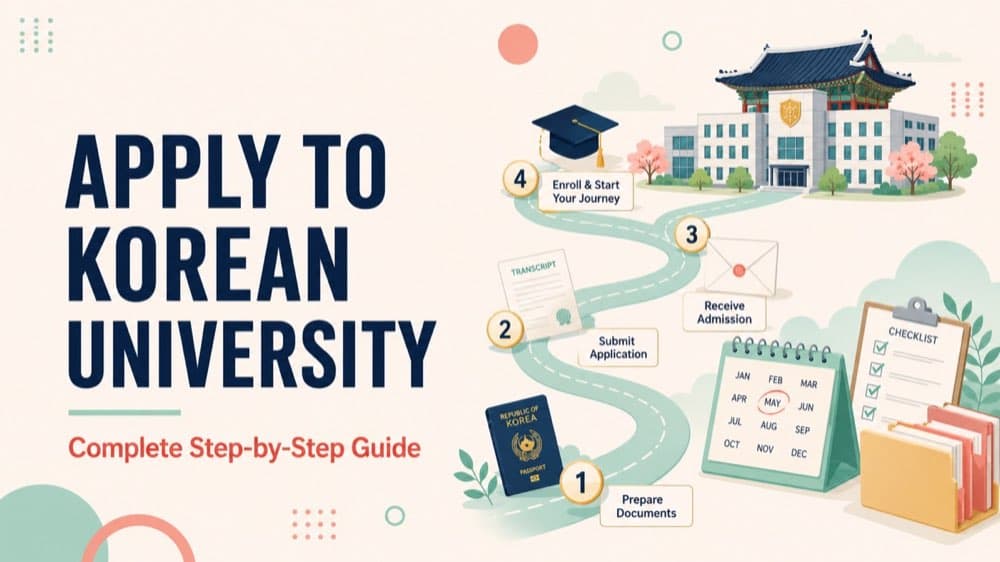
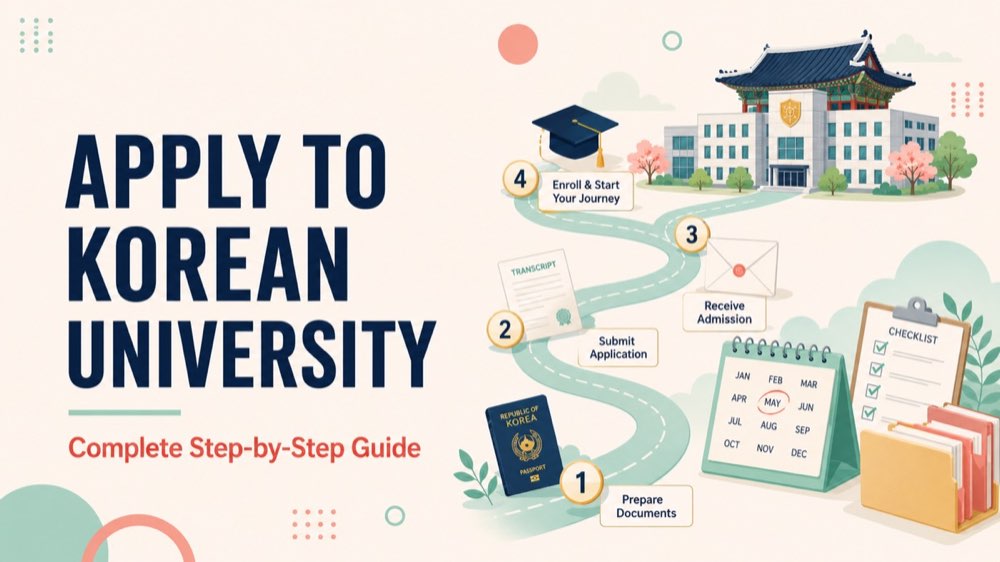
Applying to a Korean university is different from applying in the US, UK, or Australia. There's no UCAS, no Common App. Each university accepts applications independently, and administrative procedures vary from school to school.
This guide is written for international students applying to Korean universities, organized by semester timing and document handling steps from the admin office perspective. It's not just an information dump — it includes the warning signs the admin office actually watches for, the kind of "if this isn't done by now, you're in trouble" cues that internal staff use.
What students familiar with US or European university applications find most confusing about Korean applications is the lack of a unified system. Unlike Common App or UCAS where one application gets distributed to multiple schools, Korea has nothing equivalent. Each university operates its own forms, schedules, and systems. So you need to decide which universities you're targeting in advance and manage each one's timeline and requirements separately.
The Korean University Semester System
Korean universities operate on two semesters per year:
- Spring Semester (1st semester): Early March to mid-June
- Fall Semester (2nd semester): Early September to mid-December
There's a summer break (July–August) and a winter break (late December to late February). International student admissions follow this calendar.
Most Korean students enter in the spring semester, but at many universities, fall semester intake is more common for international students because it aligns better with the academic calendars of their home countries.
Working Backward from Application Deadlines
Application deadlines fall roughly 3–5 months before the semester starts.
For Spring Semester (March start) entry:
- September–November: Application submission
- December: First document review
- December–January: Interviews/additional documents
- January–February: Acceptance announcements
- February: Visa application and arrival prep
- March: Semester starts
For Fall Semester (September start) entry:
- April–June: Application submission
- June–July: First document review
- July: Interviews
- July–August: Acceptance announcements
- August: Visa and arrival prep
- September: Semester starts
These dates can shift by 1–2 weeks depending on the university, so always check the specific recruitment announcement at the schools you're applying to.
Step-by-Step Application Process
Step 1: University and Department Selection (6+ months before deadline)
A common mistake the admin office sees: assuming "Korean university = Seoul university." Regional flagship national universities in Busan, Daejeon, Gwangju, and Daegu offer strong support for international students and significantly lower tuition.
Advantages of regional flagship national universities:
- Tuition is roughly half that of private universities
- Generous international student scholarships
- Lower international student ratios mean faster Korean immersion
- Strong industry-academia ties with regional industries (e.g., Pusan — maritime/logistics, Daejeon's KAIST/Chungnam — IT/science)
Things to look into at this stage:
- Department faculty and research areas
- Percentage of courses taught in English
- International student ratio and support programs
- Dorm guarantee (many universities prioritize international students)
- Scholarship offerings
- Graduate outcomes (Korean company employment rate, graduate school admission rate)
- City characteristics (Seoul/Busan/Daejeon/Gwangju/Daegu, etc.)
Total Cost Guide by University Type (2026 estimate)
When choosing a university, consider total cost, not just tuition.
Seoul private universities (Yonsei, Korea, Sungkyunkwan, etc.)
- Tuition: about 6–8 million KRW per semester
- Dorm: about 2–3.5 million KRW per semester
- Living expenses: about 1–1.5 million KRW per month
- Annual total: approximately 25–35 million KRW
Seoul national universities (SNU, University of Seoul)
- Tuition: about 2.5–4 million KRW per semester
- Dorm: about 1.5–2.5 million KRW per semester
- Living expenses: about 1–1.5 million KRW per month
- Annual total: approximately 18–25 million KRW
KAIST, POSTECH (engineering specialty)
- Tuition: nearly free with international student scholarships
- Dorm: free or very inexpensive
- Living expenses: about 800,000–1.2 million KRW per month
- Annual total: approximately 10–15 million KRW
Regional flagship national universities (Pusan, Kyungpook, etc.)
- Tuition: about 2–3.5 million KRW per semester
- Dorm: about 1–2 million KRW per semester
- Living expenses: about 700,000–1 million KRW per month
- Annual total: approximately 12–20 million KRW
Regional private universities
- Tuition: about 4–6 million KRW per semester (50% scholarships common for international students)
- Dorm: about 1.5–2.5 million KRW per semester
- Living expenses: about 600,000–800,000 KRW per month
- Annual total: approximately 15–25 million KRW
These are 2026 estimates and vary significantly by department. With international student scholarships waiving 30–100% of tuition in many cases, your actual burden may be much lower than these figures suggest.
Step 2: Document Preparation (3–4 months before deadline)
The standard documents required by most Korean universities:
- Application form (university-specific)
- Study plan (Personal Statement)
- Self-introduction
- High school transcript (apostille or consular authentication required)
- Graduation certificate or proof of expected graduation
- 1–2 letters of recommendation
- Language proficiency scores (TOPIK or IELTS/TOEFL)
- Passport copy
- Financial proof (bank statement in your name or guardian's, typically USD 20,000+)
- Family relationship certificate (parental information)
- Health certificate (some universities)
- Photo (3.5×4.5cm specifications)
Critical admin office tip: Don't underestimate apostille and consular authentication. Processing in your home country can take 1–2 months, and delays here will make you miss deadlines. Start this before any other document.
Apostille vs. consular authentication:
- Apostille: Used between Hague Convention member countries. Issued by your home country's foreign ministry.
- Consular authentication: Used for non-member countries. Goes through your foreign ministry, then the Korean embassy.
Check which applies to your country in advance — the procedures are completely different.
Study plan writing tips:
- 2–3 pages of A4 (varies by university)
- Structure: previous education → motivation for Korean study → study plan → post-graduation plans
- Reference specific faculty and curriculum at your target department
- Include personal experiences and anecdotes so the writing doesn't read as AI-generated
Step 3: Application Submission (deadline period)
Most universities use online application systems. Some require additional original documents to be mailed separately.
Major university online application systems:
- SNU: Proprietary system
- Yonsei, Korea: Proprietary systems
- KAIST: KAIST Apply
- Many other universities: Integrated or proprietary systems
Common issues the admin office sees:
- Wrong file format (JPG submitted when PDF was required)
- Failure to follow file naming conventions (e.g., "Last_First_StudyPlan.pdf" format ignored)
- Missing attachments
- Time zone confusion (Korean Standard Time deadline)
- Recommender letters attached by the applicant when they should be submitted directly by the recommender
- File size exceeding limits
Submitting right at the deadline can fail due to system overload. Submit at least 24 hours before the deadline to be safe.
Step 4: First Review Results
Document review results are typically announced 4–6 weeks after the deadline. If you pass, you'll be notified of an interview schedule.
Reasons applications fail at this stage:
- Format errors (missing documents, incorrect forms)
- Insufficient qualifications (language scores, academic credentials)
- Weak study plan
- Recommendation letters not arriving
Recommendation letters are often submitted directly by the recommender, and many applications fail because the recommender sends them late. Ask your recommenders to submit at least one week before the deadline.
Step 5: Interview (when applicable)
Interviews can be online (Zoom, etc.) or in person (in Seoul). The interviewers are typically 2–3 department professors evaluating:
- Korean or English communication ability
- Specificity of your study plan
- Adaptability to life in Korea
- Motivation and seriousness
Common interview questions:
- Self-introduction (in Korean or English)
- Why our university?
- Why this department?
- Post-graduation plans?
- How will you adapt to life in Korea?
- Interests outside academics?
- Your strengths and weaknesses?
- Do you have questions for us? (always have 1–2 ready)
Interviews typically last 15–30 minutes. Keep answers concise and clear — long-winded responses count against you.
Step 6: Final Acceptance and Visa Application
After final acceptance, the university sends you a Certificate of Admission and the documents needed for visa application. Use these to apply for a D-2 student visa at your local Korean embassy. Visa processing typically takes 2–4 weeks.
Additional documents the school may request after acceptance:
- Proof of tuition payment
- Dorm application (if requested)
- Insurance proof
- Travel itinerary
Common Pitfalls and How to Avoid Them
Pitfall 1: "Applying early helps you stand out"
Korean universities rarely use rolling admissions like US universities. All applications received by the deadline are reviewed together, so applying early doesn't give you an advantage — although it does leave room for document corrections.
Pitfall 2: Recycling your study plan across multiple universities
If you submit the same study plan to multiple universities, it's immediately obvious. The "Why our university?" section needs to be rewritten for each one.
Pitfall 3: Choosing a school based only on having an English track
Even with an English track, integrating with Korean students requires Korean. Spending four years entirely in English defeats much of the purpose of being in Korea.
Pitfall 4: Choosing based on tuition alone
Even if tuition is low, total costs (living expenses, dorm fees, transportation) often even out. Compare comprehensive costs.
Pitfall 5: Trusting only social media reviews
Korean study abroad reviews on social media tend to highlight only the positive aspects. For realistic information about academic intensity, relationships with Korean students, and administrative challenges, check official school channels or interview alumni directly.
Frequently Asked Questions
Q: Can I apply for an English-track program without TOEFL/IELTS scores?
Some universities accept a graduation certificate from an English-speaking country in lieu of test scores. Otherwise, scores are required.
Q: Can I apply years after high school graduation?
Most undergraduate programs recommend applying within 5 years of graduation, though there's often no explicit limit. You'll need to clearly explain what you did during any gap years.
Q: Are transfer years recognized?
Some universities accept second- or third-year transfers. Whether your home country credits transfer depends on the school.
Q: How much is the application fee?
Typically USD 50–150. Some universities waive fees for GKS applicants.
Q: How many universities can I apply to in one cycle?
There's no limit. Most students apply to 5–7 universities, divided into safety, target, and reach schools. Consider how many sets of documents and application fees you can manage.
Q: Are there penalties for declining an offer?
Most universities don't penalize you, but tuition refund policies vary by school. After enrollment, you may only get partial refunds, so check carefully.
Q: Can minors apply independently?
Yes, but additional requirements apply: parental consent, guardian financial proof, and information on a guardian or sponsor in Korea. Minors may face additional verification at the D-2 visa stage.
Q: Can applicants who completed military service apply?
Yes. Military service in your home country doesn't affect Korean admissions. Clearly explain the service period in your study plan so it's not misread as an academic gap.
Q: How should I communicate with universities during the application process?
Most universities have an English-language email contact for the international office. Send polite, professional emails. Korean-style formal English emails tend to be most effective.
Final Thoughts
Korean university applications are a race against time. Document preparation takes longer than you'd expect, and Korean administrative systems prioritize formal correctness. Last-minute preparation guarantees problems.
The best strategy is to start six months before the deadline. That gives you time to prepare documents thoroughly, strengthen your language scores, and refine your study plan.
The most painful cases the admin office sees are students who clearly have the credentials but missed the deadline because they started too late. Korean university admissions aren't really a question of whether you can get in — they're a question of whether you can meet the deadlines.
You may also like
You may also like


Related Posts

Studying Outside Seoul? Five Things to Check Before You Choose
Seoul is not the only option — but before choosing a university elsewhere in Korea, check what an ordinary weekday would look like: the dorm, the commute to class, meals and shopping, the courses and English help you need, and whether the location fits your plans.

English-Taught Programs in Korea: What to Check Beyond the Classroom
"English-taught" answers one question — can I study here with limited Korean? — but not the rest. Here is what to check about the curriculum, graduation rules, advising, administration, and daily life before you choose a program.
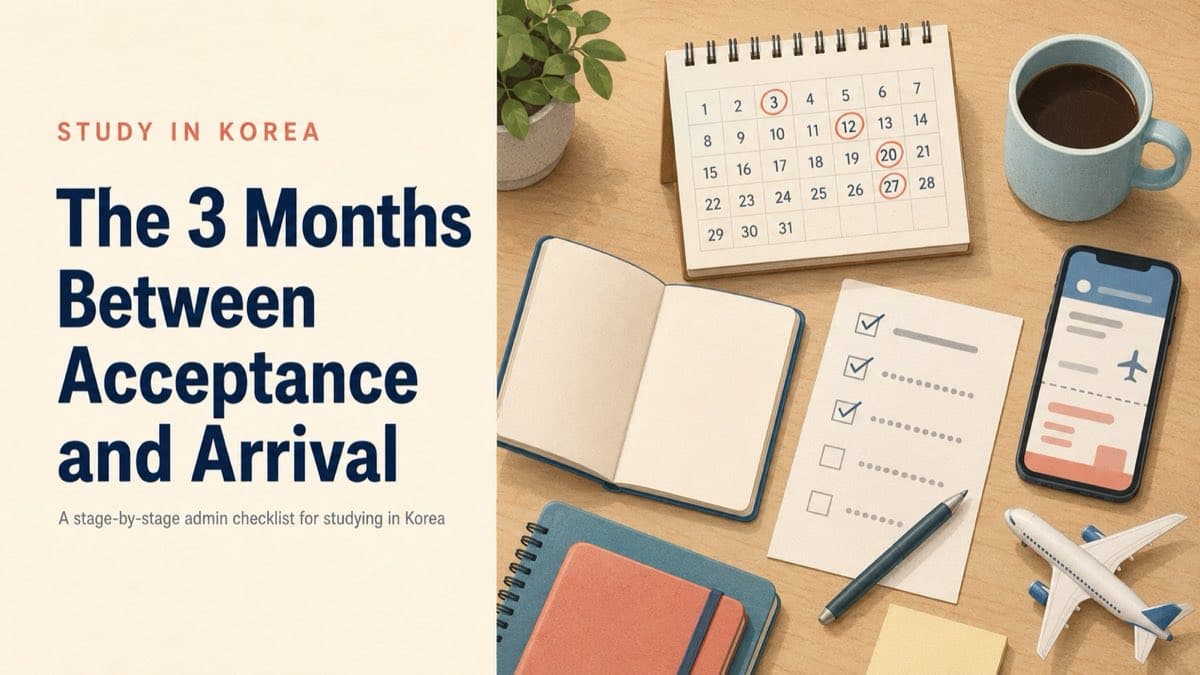
The 3 Months Between Acceptance and Arrival: A Stage-by-Stage Admin Checklist for Studying in Korea
From acceptance email to your first month in Korea — a five-stage admin checklist covering visa, dorm, finances, ARC, and insurance, written from a university international office perspective.