How to Order Food in Korea: A Practical Restaurant Guide for First-Time Visitors
Should you sit down? Is that screen for ordering or the waiting list? Is the price per person? A step-by-step guide to Korean restaurants: reading serving sizes, using kiosks and table tablets, avoiding double orders, side dishes, dietary requests, paying, and the five sentences to save before your first meal.


You have found a restaurant that looks perfect. The food in the window looks delicious, the price seems reasonable, and you are ready to eat.
Then you open the door and stop.
Should you sit down? Is that screen for ordering or joining a waiting list? Why is nobody bringing a menu? And is the price for one person or the whole dish?
These small questions can make a simple meal feel surprisingly complicated. You do not need fluent Korean to get through them. A few useful words, a little observation, and one clear question at a time will help.
Here is a practical guide to getting from the restaurant entrance to a finished meal.
1. At the door, check what happens before you sit down
Take a moment to look around the entrance. Is a staff member seating customers? Is there a waiting list? Are people ordering at a counter before choosing a table?
If you are unsure, start by telling the staff how many people are eating.
| What you mean | Korean to say or show |
|---|---|
| One person. | 한 명이에요. |
| Two people. | 두 명이에요. |
| Can I eat here by myself? | 혼자 식사할 수 있나요? |
| Can we order now? | 지금 주문할 수 있나요? |
| Should we order before sitting down? | 먼저 주문하면 되나요? |
The question about ordering now is particularly useful if you arrive near closing time. An open door does not necessarily mean the kitchen is still accepting orders. Look for 라스트오더, meaning "last order," and 브레이크타임, meaning a break between service periods.
If an entrance screen asks for a phone number, do not assume you must register with a Korean number to eat there. Ask staff whether they can help you join the queue. The available method depends on the restaurant.
A polite question is easier than entering a random number or accidentally starting the wrong process.
2. Before choosing, check how much food you are ordering
The most useful thing on the menu may be the small text beside the price.
1인분 means one serving. 2인분 이상 주문 means a minimum order of two servings. 소, 중, 대 mean small, medium, and large; those labels do not tell you an exact number of diners.
For example, imagine a menu listing a dish at ₩15,000 per serving with a two-serving minimum. Ordering the minimum would cost ₩30,000 for that dish, before any separately priced extras. This is an illustration, not a current restaurant price.
If you are alone, check both whether the restaurant accepts solo diners and whether your chosen dish has a minimum order. A restaurant may offer individual meals while requiring a larger order for a particular shared dish.
Use these questions:
이 메뉴는 한 명도 주문할 수 있나요?
Can one person order this dish?이 가격은 1인분 가격인가요?
Is this the price for one serving?밥이 포함되어 있나요?
Is rice included?
For a straightforward first meal, look for a menu that clearly offers an individual bowl, plate, or set. Still check the description: a photograph alone will not tell you everything included in the price.
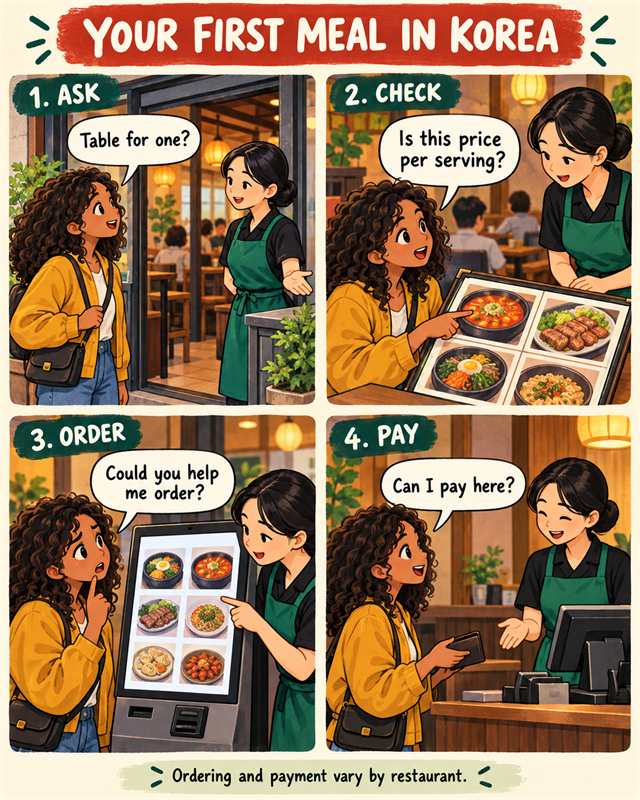
3. Work out which ordering method the restaurant uses
You may encounter staff taking orders, a counter, an entrance kiosk, or a tablet attached to your table. Follow the instructions at that restaurant rather than assuming the previous place worked the same way.
At a staffed table, you can point to the menu and say:
이거 하나 주세요.
One of this, please.
To ask for an English menu:
영어 메뉴 있나요?
Do you have an English menu?
At a kiosk or table tablet, first look for a language button, a globe icon, or "English." There may be no English option. If that happens, showing staff the item you want is a reasonable next step.
These labels can help you understand the screen:
| Korean | Meaning |
|---|---|
| 매장 / 매장 식사 | Eat in |
| 포장 | Takeaway |
| 단품 | Item on its own, rather than a set |
| 세트 | Set or combo |
| 추가 | Add an extra |
| 수량 | Quantity |
| 주문하기 | Place order |
| 결제하기 | Pay |
| 이전 / 취소 | Back / Cancel |
Before confirming, check the food, quantity, optional extras, and total. A picture of a meal does not always mean every pictured item is included in the option you selected.
Keep the receipt or order number if one is issued. It may be how you identify your food at the pickup counter.
4. If the screen gets confusing, stop before ordering twice
One easy mistake is assuming nothing happened because no food has arrived yet. You tap again, start over, and discover you have ordered the same meal twice.
If the screen showed a confirmation or your card appeared to be charged, ask staff to check before repeating the order.
주문이 들어갔나요?
Did my order go through?결제가 됐는지 확인해 주세요.
Please check whether the payment went through.
Show the receipt, order number, or relevant payment screen. You do not need to hand over your unlocked phone with unrelated personal information on display.
If an overseas card does not work at the kiosk, ask whether staff can help you pay at the counter. Another terminal or payment method may be available, but do not assume that every restaurant can offer the same alternatives. Having a backup payment method is useful.
For a phone-number prompt you cannot complete, use:
한국 전화번호가 없어요. 주문을 도와주실 수 있나요?
I do not have a Korean phone number. Could you help me order?
You are trying to buy lunch, not pass a technology test. Asking for help is a perfectly reasonable part of ordering.
5. Find the water, utensils, and side dishes
Once seated, look for a self-service water area and a utensil holder or table drawer. Some tables also have a call button for requesting help; if there is none, a polite 저기요 ("excuse me") will do.
The small side dishes served with a Korean meal are called banchan. Standard included side dishes are often refillable without an extra charge, but check the restaurant's signs. Separately priced dishes, rice, and special extras are not automatically free.
Useful questions are:
물은 어디에 있나요?
Where can I get water?반찬 더 받을 수 있나요? 추가 요금이 있나요?
Could I get more side dishes? Is there an extra charge?
At a self-service station, take a little first and return if you need more.
6. Say what you need before confirming the order
If you dislike spicy food, it is easier to ask before paying than after the dish arrives.
이거 매운가요?
Is this spicy?안 맵게 해주실 수 있나요?
Can you make it without the heat?
The kitchen may not be able to change a sauce or broth prepared in advance. Ask for another dish if the modification is not possible.
For a dietary restriction, be specific about the ingredient you need to avoid. Pointing to a vegetable photograph or choosing a dish because it does not look red is not a reliable way to understand its ingredients.
A translation app can help you read a menu or show a short request. Keep the original text visible so staff can see exactly which dish you mean. If you have a food allergy, tell staff explicitly before ordering and have them confirm whether they can accommodate it; a translated dish name is not confirmation that the food is suitable.
For an ordinary preference, this simple sentence may be enough:
고기 빼고 만들 수 있나요?
Can you make it without meat?
That sentence requests a change. It does not confirm that the broth or sauce contains no animal ingredients. Ask separately if those details matter to you.
7. Check whether you have already paid
A kiosk payment at the start and a bill at the end are different systems. A table tablet may send an order without collecting payment, so seeing "order complete" does not always mean you have paid.
When you are ready to leave, ask if necessary:
계산은 어디에서 하나요?
Where do I pay?이미 결제했는데 확인해 주실 수 있나요?
I have already paid. Could you check?
If you have not paid, 계산할게요 means "I'd like to pay." Follow the staff's directions and keep your table number or order slip handy if one was provided.
For a group, ask whether separate payments are possible before presenting several cards. The restaurant's checkout arrangements may limit how it can divide the bill.
You generally do not need to leave a tip at an ordinary Korean restaurant. If the total differs from what you expected, ask to see the itemized bill instead of assuming the difference is a tip or service fee.
8. Save these five sentences before your first meal
You do not have to memorize every phrase in this guide. Save these on your phone and show the relevant one when you need it.
| Situation | Sentence to show |
|---|---|
| You are alone. | 혼자 식사할 수 있나요? |
| You want the pictured item. | 이거 하나 주세요. |
| You do not understand the ordering screen. | 주문하는 것을 도와주실 수 있나요? |
| You are unsure about the price. | 총 얼마인가요? |
| You are ready to pay. | 계산할게요. |
For your first visit, a manageable goal is enough: find out where to order, confirm the amount of food and price, and check how payment works. You can learn the rest one meal at a time.
Soon the hidden cutlery drawer will stop being a mystery, the screen will look less intimidating, and you can spend more time deciding what you actually want to eat.
You may also like
You may also like



Related Posts

Korean Hair Salon Phrases: How to Ask for a Haircut You Actually Want
Worried about explaining a haircut in Korean? Short phrases for a Korean hair salon: asking about appointments, confirming the service and total price, using a reference photo, agreeing on length before cutting, speaking up during the wash, and checking the result, plus a practice conversation.

Korean Clothing Store Phrases: Try Things On, Find Your Size, and Ask About Exchanges
Shopping for clothes in Korea? Short Korean phrases for browsing, asking for another size or color, using the fitting room, checking prices and alterations, asking about exchanges and refunds before paying, answering checkout questions, and returning an item for a different size.

Korean Taxi Phrases: Show Your Destination, Ask Questions, and Pay with Confidence
Taking a taxi in Korea without speaking Korean? Short phrases to show your destination, answer the driver's questions, explain luggage and passengers, ask about time and fares, request a safe stop, and confirm payment and receipts, plus a practice conversation.