Why Asking Someone's Age Isn't Rude in Korea: How Korean Relationship-Setting Actually Works
In Korea, '몇 살이세요?' isn't intrusive curiosity — it's relationship-setup. Why Korean grammar can't run without your birth year, and how foreigners can respond naturally.
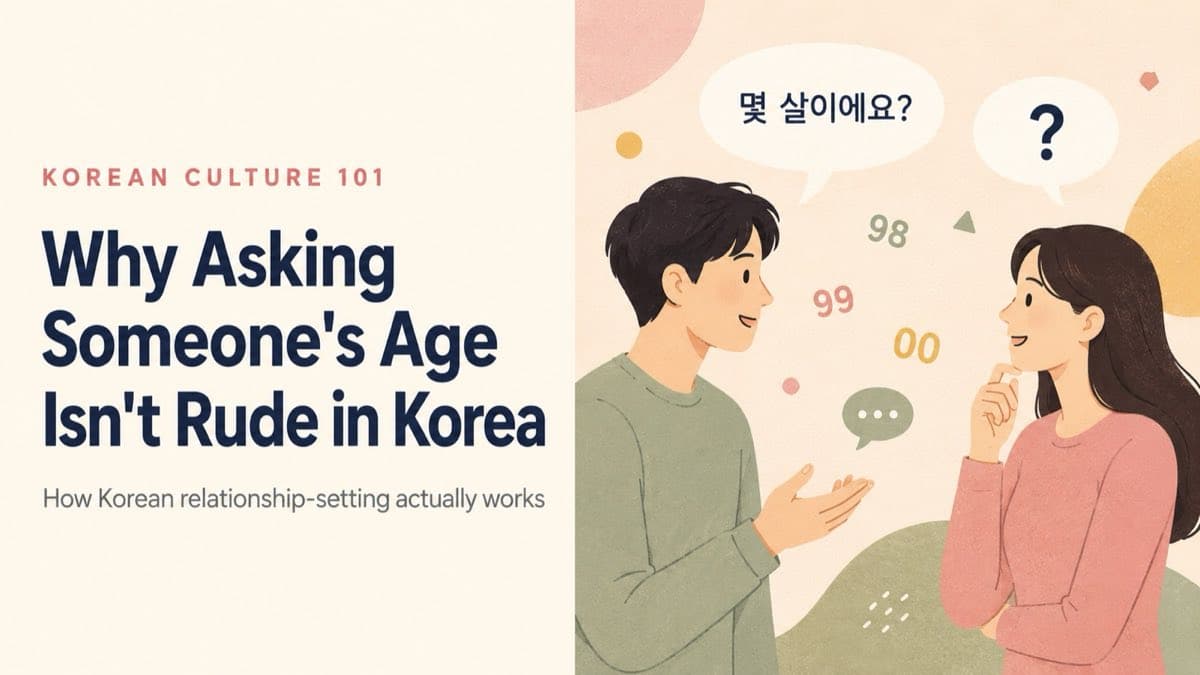
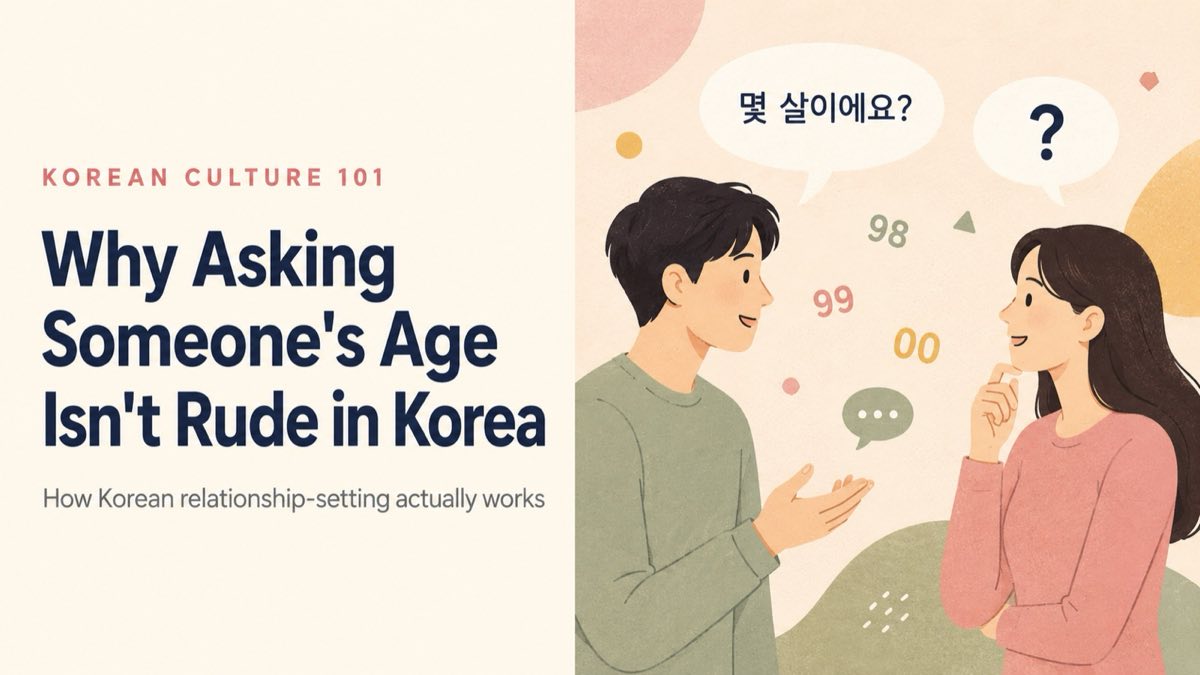
In most Western countries, asking someone's age on first meeting is rude — especially asking a woman. English, French, German, the social code is the same. In Korea, it's the opposite. On first meetings, in business introductions, sometimes built into the self-introduction itself, you'll hear: "몇 살이세요?" (How old are you?) or "몇 년생이세요?" (What year were you born?).
This is one of the first culture shocks foreigners encounter when they start making Korean friends. Some get offended; others smile awkwardly and dodge. But in Korea, this question means almost the exact opposite of what it means in English.
This post explains why age matters so much in Korea, what linguistic and cultural structure sits underneath, and what's actually the most natural response when someone asks.
In Korea, Age Isn't Information — It's Relationship Setup
In English, "How old are you?" is a factual question. The answer doesn't change how the rest of the conversation works. In Korean, "몇 살이세요?" is something else entirely. A more accurate translation would be:
"How should we set the titles, speech level, and hierarchy between us?"
Korean is a language with hierarchy built directly into its grammar. The phrase "Did you eat?" doesn't have a single fixed form. To someone even one year older, it must become "밥 드셨어요?" To someone the same age, "밥 먹었어?" To someone younger, also "밥 먹었어?" — but with a completely different relational meaning. And the title splits across forms: hyung, eonni, nuna, oppa, dongsaeng, chingu (friend).
Put simply: Koreans physically cannot speak their own language precisely without knowing your age. That's the real reason "몇 살이세요?" comes out so naturally, almost like a greeting. The English equivalent isn't "How old are you?" — it's closer to "What's your name?" That basic.
The Uniquely Korean Concept of "Fast Year" (빠른 년생)
There's a second layer of complexity. People born in January or February are called "빠른 년생" — "fast-year" births — because under the old school enrollment system, they entered school a year earlier than their birth-year cohort. As a result, they often became friends with the cohort one year above their actual birth year.
For example, someone born in March 1998 and someone born in January 1999 may well have been in the same school year. By Korean school-cohort logic, they're "the same age, friends." By modern legal age, they're one year apart. Because of this ambiguity, even between Koreans, the question more often takes the form "몇 년생이세요?" (What year were you born?) — because it pins down the school cohort exactly.
(A note: Since the "International Age Unification Law" took effect in June 2023, official documents use international age. But everyday social hierarchy still runs on birth year and school cohort. Laws change; culture changes more slowly.)
Age in the Korean Workplace — An Even Stricter Operating System
In the Korean workplace, age takes on yet another layer of meaning. Even between people of the same job title, age differences alter how they address each other and which speech level they use.
Consider two people both holding the title of "대리" (assistant manager). A is born in 1990, B in 1985. Even though they have the same title, A will usually address B as "선배님" (senior) or "B 대리님," and use formal speech. Same rank, but a second hierarchy — age — runs alongside the official one.
This is deeply confusing for foreigners. "Why is one same-rank colleague speaking casually to me and the other one not?" The answer is simple: Korean workplaces run two hierarchies simultaneously — job title and age — and defer to whichever is higher.
How Foreigners Can Respond Naturally
The simplest move is to just state your birth year:
"I was born in 1998." Or in Korean: "98년생이에요."
The Korean person on the other side will sort out the titles and speech level from there. Korea's relational matching algorithm only needs one line of input: your birth year.
Don't want to answer? More and more Koreans now respond with something like "그건 굳이 안 알려드려도 되죠?" ("I don't really have to share that, right?") — and it lands fine. Women in their late twenties and beyond use this response more frequently. But in workplaces or schools, where hierarchy actively operates, just answering honestly usually unblocks the relationship faster. "I don't know if she's one year older or younger than me, so I don't know what to call her" is a surprisingly real source of stress in Korean offices.
One small tip: in Korean, "98년생이에요" sounds more natural than "I'm twenty-eight years old." Koreans use the birth-year form much more often than the age form.
One Thing Foreigners Should Know — Don't Pretend to Be the Same Age
When a Korean friend learns you're the same age, sometimes their entire speech pattern shifts on the spot. "Oh, we're the same age! Let's drop the formalities."
From a foreigner's side, this can feel jarring: "Wait, I thought we were already friends. Why is the tone suddenly different?" In Korea, "동갑" (same age) isn't just a fact — it's closer to a friendship certification. The moment same-age status is confirmed, the relationship is redefined as "friends" (casual speech, no hierarchy). It's actually a signal of Korean-style intimacy.
On the flip side, pretending to be the same age when you're actually a year older or younger creates real awkwardness later. From the Korean friend's perspective, it's less "Why did you lie?" and more "We've been using the wrong titles this whole time." Honesty just runs smoother.
Where Age Hierarchy Is Weakening — and Where It's Holding Strong
Interestingly, there are spaces in Korea where age hierarchy has been visibly weakening:
- Startups and IT companies: English names, no titles, age rarely comes up.
- Foreign companies: Even their Korean branches inherit some of the headquarters' culture and ask age less often.
- Among people in their early twenties: One- or two-year gaps are increasingly ignored.
And the spaces where age hierarchy remains firmly in place:
- Public institutions, universities, hospitals, the military: Both title and age operate strictly.
- Holiday family gatherings: Relative titles are sliced into very fine age-based categories.
- Daily service interactions — taxis, restaurants: Honorifics like "기사님," "이모님," "사장님" — all age-estimation-based — remain everyday usage.
Closing Thoughts
When someone asks your age in Korea, don't take offense. It isn't an evaluation. It's the continuation of a greeting — they're trying to figure out how to talk with you accurately. If "Nice to meet you" is the first greeting in English, then "setting the relational coordinates" is the first greeting in Korean.
When someone in Korea asks your age, the underlying message is usually "I want to get along with you, and I want to speak with you precisely." Once you can hear that signal underneath, relationships in Korea become a lot smoother.
You may also like
You may also like


Related Posts

Korean Hair Salon Phrases: How to Ask for a Haircut You Actually Want
Worried about explaining a haircut in Korean? Short phrases for a Korean hair salon: asking about appointments, confirming the service and total price, using a reference photo, agreeing on length before cutting, speaking up during the wash, and checking the result, plus a practice conversation.

Korean Clothing Store Phrases: Try Things On, Find Your Size, and Ask About Exchanges
Shopping for clothes in Korea? Short Korean phrases for browsing, asking for another size or color, using the fitting room, checking prices and alterations, asking about exchanges and refunds before paying, answering checkout questions, and returning an item for a different size.

Korean Taxi Phrases: Show Your Destination, Ask Questions, and Pay with Confidence
Taking a taxi in Korea without speaking Korean? Short phrases to show your destination, answer the driver's questions, explain luggage and passengers, ask about time and fares, request a safe stop, and confirm payment and receipts, plus a practice conversation.