Korean Workplace Culture: What Foreigners Should Know About Office Etiquette
A practical manual for foreigners working in Korean offices — hierarchy, titles, greetings, hoesik, ppalli-ppalli, and the top 5 mistakes that quietly hurt your reputation.


If you've started working at a Korean company or doing business with Korean firms, the first wall you hit might not be your work skills — it's Korean workplace culture. Hierarchy, hoesik (company dinners), titles, reporting practices — many things differ sharply from Western office norms. Without understanding them, you can come across as rude without meaning to, or end up feeling distant from your colleagues.
The good news is that Korean workplace culture is changing fast. With the MZ generation taking center stage and more global collaboration, much of the rigid old culture has softened. But Korea-specific patterns still exist. This post is a practical manual for foreigners working in Korea.
Hierarchy and Titles — The First Hurdle
The first thing you encounter at a Korean company is the rank system. A typical hierarchy looks like this:
Sawon → Daeri → Gwajang → Chajang → Bujang → Isa → Sangmu → Jeonmu → Busajang → Sajang
New hires usually start as sawon or juim. Promotions typically come every 3–4 years, and reaching bujang often takes 15–20 years. Recently, many companies have simplified this with titles like "Pro," "Manager," or "Team Lead."
Titles matter a lot. Coworkers in Korea are rarely called by first name alone. The standard form is "surname + rank + nim." For example, Mr. Kim at gwajang level is "Kim Gwajang-nim" and Mr. Park at bujang level is "Park Bujang-nim."
Age also matters. Apart from job rank, there's an age-based hierarchy. Koreans often ask each other's age early in a relationship — this isn't intrusive curiosity but a social step used to decide proper titles and speech levels.
Greeting Etiquette — Setting the First Impression
Greetings in Korean offices aren't a formality — they're an important form of respect. The angle of your bow changes based on your relationship. A light nod at about 15 degrees works for peers or close colleagues, a standard bow at 30 degrees for seniors and supervisors, and a deeper 45-degree bow for executives or formal apologies.
Business card exchange is a key ritual in Korean business. Both giving and receiving should be done with two hands. Don't tuck the card straight into your pocket — set it neatly on the table during the meeting as a sign of respect.
Your first day typically involves introducing yourself to the whole team. A simple "Hello, I'm OOO, the new addition to the OO team. I look forward to working with you" is enough. For foreigners, memorizing this in Korean is well worth the effort.
Hoesik — The Other Side of Korean Office Life
Hoesik is one keyword you can't skip when discussing Korean workplace culture. It refers to team or department gatherings centered on food and drinks. It's not just socializing — it's seen as a chance to build bonds and exchange the kind of information that doesn't make it into meetings.
Hoesik typically has a structure: first round (1-cha), second (2-cha), and sometimes third (3-cha). The first round usually involves a sit-down meal — samgyeopsal, galbi, or raw fish — with soju and beer. The second moves to a pub or noraebang (karaoke). The third is a late-night drink with whoever stayed.
The basics of drinking etiquette: wait until a senior has raised their glass before drinking, pour drinks for seniors with both hands, and receive with both hands. When drinking in front of a senior, turn your head slightly away. If you don't drink, say so up front.
For foreigners, it's best to mention early on if you don't drink. Korean workplaces are increasingly aware that pressuring people to drink isn't acceptable, and religious or health reasons are well respected. Newer alternatives like short lunch hoesik, movie outings, and cafe hoesik are also growing.
Work Style — Ppalli-Ppalli and the Reporting Culture
Ppalli-ppalli ("hurry-hurry") culture is the most distinctive feature of Korean offices. Decision-making is fast, and results are expected fast. A task that might take a week at a Japanese company is often expected within 2–3 days at a Korean one.
This is both a strength and a weakness. Speed and momentum are real advantages of Korean companies, but rushing without enough review also leads to repeated mistakes.
Overtime culture has improved a lot. The 52-hour workweek introduced in 2018 set legal limits on excessive overtime. Still, some industries and companies have more late nights than others, so it's worth asking about overtime norms before joining.
The reporting culture is at the heart of Korean offices. Sharing progress with your supervisor frequently and clearly is considered a virtue. Small updates are routinely sent via messengers like KakaoTalk or internal tools, and major matters are written up in formal reports. A common foreigner mistake is thinking, "I'll just figure it out and they'll see the results," then under-reporting. In Korea, this often reads as "uncooperative."
Lunch Culture and Daily Etiquette
Korean offices have a strong culture of eating lunch together. Honbap (eating alone) is becoming more accepted, but if you're a new hire or a foreign employee, eating with the team for the first few months is a good move. It's a key time for building relationships and informal information exchange.
Splitting the bill varies by company. Some teams have the youngest member pay and settle up later, others go Dutch, and sometimes a senior treats the team.
Post-lunch coffee is practically a ritual. Going to a cafe after lunch is core team-building time.
Top 5 Mistakes Foreigners Make
- Dropping titles: "Where did Cheolsu go?" should be "Where did Kim Daeri-nim go?"
- Disagreeing too directly with seniors: Rather than direct pushback, indirect framing works better.
- Skipping hoesik without notice: If you can't attend, give advance notice politely.
- Always eating lunch alone: You miss key chances to build relationships.
- Slow KakaoTalk replies: Quick responses are valued in Korean offices.
Closing Thoughts
Korean workplace culture can feel complex and demanding at first. Hierarchy, hoesik, titles, reporting — there's a lot that's unfamiliar. But underneath sits a culture of jeong — treating colleagues like family. Korean coworkers may seem reserved at first, but once they open up, they often become long-term friends and reliable allies. If you're working in Korea, rather than rejecting this culture, find your own balance within it.
You may also like
You may also like



Related Posts

Starting a Job in Korea With Almost No Handover? Start Here
Someone hands you a short document and says, "You will figure out the rest as you go." Five questions that make the first week easier — what is due, where the files are, and whom to ask — especially if you are also getting used to working in Korean.

"Please Review This": What Should You Actually Do at Work in Korea?
"Please review this," "for your reference," "as soon as possible" — you understood the words, but did you understand the task? A few short questions that clear up everyday work requests in a Korean office.
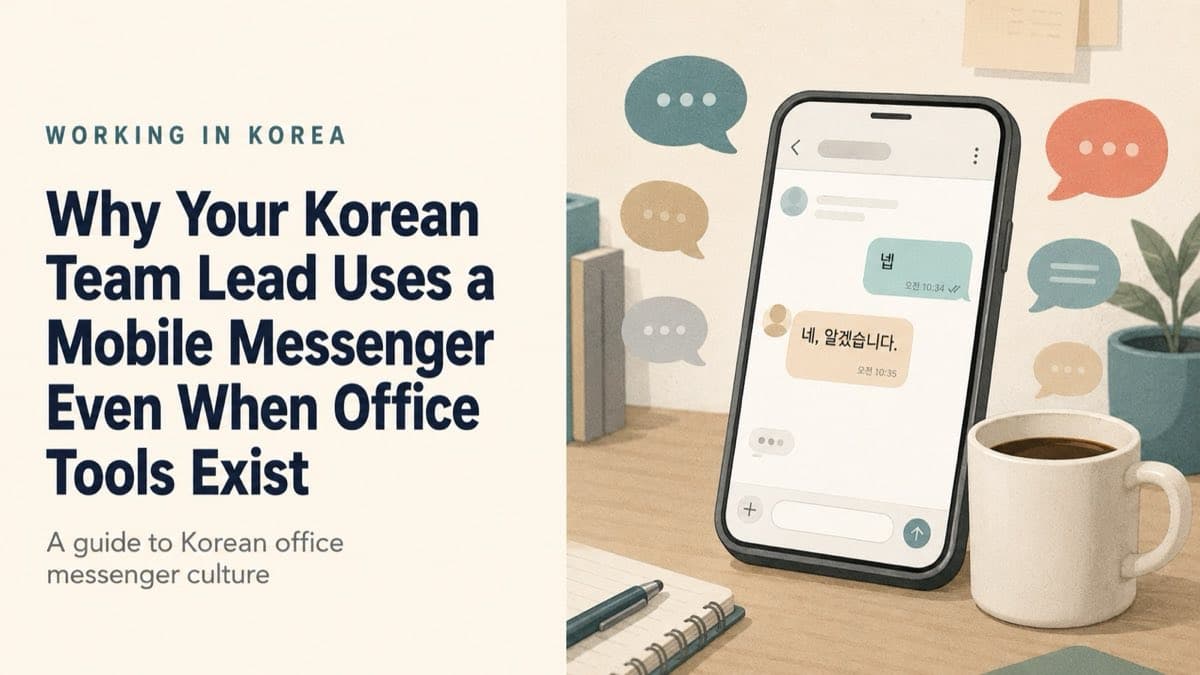
Korean Office Messenger Culture: Why Your Team Lead Uses KakaoTalk Even When Slack Is Installed
Why Korean offices run Slack and KakaoTalk in parallel — and how foreigners can decode the subtle signals behind 넵, 네, ㅇㅇ, and 읽씹 without quietly hurting their reputation.