Korean Office Messenger Culture: Why Your Team Lead Uses KakaoTalk Even When Slack Is Installed
Why Korean offices run Slack and KakaoTalk in parallel — and how foreigners can decode the subtle signals behind 넵, 네, ㅇㅇ, and 읽씹 without quietly hurting their reputation.
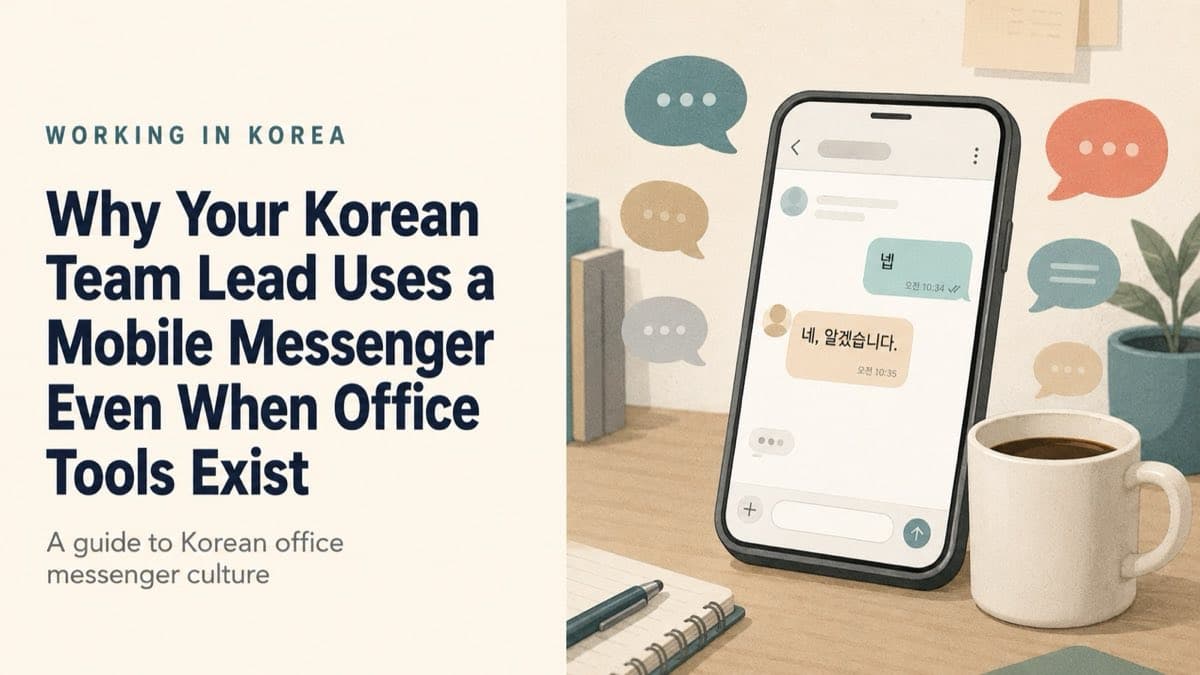
One of the first shocks for foreigners working at a Korean company is this:
"Our office has Slack and Teams, so why is the team lead sending me work assignments on KakaoTalk?"
At first it looks like a simple IT-tooling mess. But after about six months at a Korean company, most foreign employees converge on the same conclusion: this isn't an infrastructure problem. It's a direct reflection of how Korean workplace communication culture actually operates.
This post explains how messengers really work in Korean offices, why the official tool and the unofficial tool run in parallel, and what foreigners need to watch out for in that overlap.
The Dual-Channel Structure: Official vs. Unofficial
On the surface, most Korean companies use official collaboration tools — Slack, Teams, Jandi, Dooray, LINE WORKS. The larger the company, the heavier the reliance on the official channel.
But running alongside, always, is KakaoTalk. Team group chats, project group chats, executive-reporting group chats, casual after-work group chats. It's completely normal for one employee to be in 5–10 work-related KakaoTalk rooms.
The division of labor between the two roughly follows this logic:
- Official messengers (Slack, Teams, etc.): Things that need to leave a record. Approval chains, document sharing, formal meeting minutes, external partner communications.
- KakaoTalk: Things where speed matters more than the paper trail. Urgent pings, lunch plans, internal political information, "how should I handle this right now?" questions.
It looks inefficient, but it's actually a compromise between Korea's "빨리빨리" (hurry-hurry) decision-making culture and its record-keeping obligations. And honestly, KakaoTalk is already integrated into Koreans' nervous systems. Opening a separate app feels slower than just tapping the messenger that's already open on their phone.
The Signals Foreigners Miss — The Subtle Difference Between "네," "넵," and "ㅇㅇ"
Korean messenger culture runs on a system of non-verbal signals that foreigners can almost never decode on their own. Take the variations of "네" (yes). Dictionary-wise, they all mean "Yes." Workplace-wise, they're radically different.
- "네": Polite but slightly distant. Used most by new hires in their first month. The version Korean textbooks teach.
- "넵": The safest, most universal response. The single most common reply in Korean offices. Slightly lighter and slightly more eager than "네."
- "네!": Enthusiastic, but overdone if used too often. Appropriate when you're new; you'll want to tone it down with experience.
- "넹": Only for close colleagues. Sending this to a superior is awkward.
- "녱," "네에": Affectionate variants. Inappropriate in professional settings.
- "ㅇㅇ": For peers and juniors only. Sending this to a superior is, in itself, an incident.
- "넵넵": Doubled for emphasis. Slightly familiar, conveys a quick response. Safe between peers.
The most common mistake foreigners make in Korean-language messaging is sticking with "네" forever. It's not wrong — but it makes you look like a perpetually distant new hire. After about a month, gradually shift to "넵." The safest learning method is to watch what your Korean colleagues are using and follow them.
Emoticons — Another Non-Verbal System
KakaoTalk has a thriving paid emoticon market, and Korean office workers use it actively. But there are subtle rules.
- Emoticons to superiors: Usually don't. If you must, only with polite, neutral characters (a clean bow, a respectful greeting).
- Emoticons to peers: Freely used. One of the main tools for expressing closeness.
- Emoticons in group chats: Used as atmosphere-setting. Post-meeting "수고하셨습니다" ("good work") stickers are everyday.
If you want to express a bit of personality as a foreign employee, buying one well-regarded, neutral emoticon set is a small but effective investment. They're available directly in KakaoTalk for about 2,000–3,000 KRW.
Do You Have to Reply After Hours? — The Most Contested Topic
This is one of the most divisive issues in Korean workplaces.
Legally, the 52-hour workweek (enforced since 2018) and a strengthening "no after-hours work instructions" norm in the 2020s mean that you formally have no obligation to reply. Some municipalities and companies have even adopted internal rules explicitly banning KakaoTalk work instructions.
In practice, it varies wildly by company size, industry, and team lead's style. Foreign companies, large conglomerates, and IT startups tend to have fewer after-hours messages. SMEs, parts of the public sector, and traditional industries still see plenty.
A safe strategy for foreign employees:
- Genuinely urgent issues (a missing document for tomorrow's meeting, an external incident): Reply briefly. Late is fine; silence is not.
- General work questions: Replying the next morning is fine. "넵, 내일 아침 출근하자마자 확인해드리겠습니다" ("Got it, I'll check first thing tomorrow morning") works.
- Social or after-work chatter: Respond as much as you feel comfortable. Silence is mostly okay.
The key isn't whether you reply — it's becoming predictable. If you sometimes reply instantly, sometimes the next day, and sometimes ignore the message entirely, misunderstandings build up. Set your own rule, and let colleagues learn it through your consistency.
The Meaning of "Read but Not Replied" (읽씹) — The Biggest Gap from English-Speaking Cultures
"읽씹" — reading a message but not replying — is a strongly negative signal in Korean messenger culture.
In English-speaking environments, "Seen, no reply" is fairly tolerable. It's read as "they're busy right now." In Korean offices, it reads differently. "읽씹" tends to be interpreted as "something is wrong with this relationship" or "they're deliberately ignoring this task."
Even when you can't fully answer, sending one short line first is the Korean-style protocol:
- "지금 회의 중입니다. 끝나고 답드릴게요." ("In a meeting now, I'll reply after.")
- "확인했습니다. 자료 보고 다시 연락드리겠습니다." ("Got it. I'll get back to you after checking the documents.")
- "잠시만요, 한 시간 내로 답드릴게요." ("One moment, I'll reply within an hour.")
The presence or absence of that one line is what separates someone seen as "thoughtful" from someone seen as "frustrating to work with" in a Korean office.
Five Survival Rules for Foreigners on Korean Workplace Messengers
To close, five rules for avoiding messenger-related incidents at Korean companies.
- Keep both official and unofficial channels open. If you don't use KakaoTalk, you'll be cut off from the information flow.
- Aim for replies within 10 minutes by default. If a full answer will take longer, send "확인 중입니다" ("checking now") first.
- For superiors, always use "넵" or "네, 알겠습니다." Never "ㅇㅇ," "넹," or a standalone emoticon.
- Let colleagues lead the tone-setting in group chats. A foreigner cracking the first joke usually lands awkwardly. Follow the mood; don't set it.
- Keep your after-hours response pattern consistent. A single steady rule beats reacting differently every time. Predictability is what earns reputation.
Closing Thoughts
In Korean offices, messengers aren't just tools — they're mirrors of the relationship. Which channel you use, which words you choose, how quickly you reply, whether you send emoticons — all of it becomes information about you. Korean colleagues read it unconsciously and form impressions of you unconsciously.
Knowing this and observing deliberately for just one month accelerates your adjustment to a Korean office noticeably. And after about six months, you'll catch yourself naturally typing "넵" without thinking about it. That's the real sign you've adapted to Korean workplace culture.
You may also like
You may also like



Related Posts

Starting a Job in Korea With Almost No Handover? Start Here
Someone hands you a short document and says, "You will figure out the rest as you go." Five questions that make the first week easier — what is due, where the files are, and whom to ask — especially if you are also getting used to working in Korean.

"Please Review This": What Should You Actually Do at Work in Korea?
"Please review this," "for your reference," "as soon as possible" — you understood the words, but did you understand the task? A few short questions that clear up everyday work requests in a Korean office.