Korean University GPA System Explained: A Complete Guide for International Students
Why a 4.5 scale, why A0, and how to actually calculate your Korean GPA — a behind-the-desk explanation of the Korean university grading system, conversion tables, and GPA strategies for international students.
An honest explanation from someone who works behind the administrative desk
📌 This article is written from the perspective of someone who currently works as administrative staff at a Korean university. After years of issuing transcripts to international students and answering GPA conversion questions, I've compiled everything you need to know about the Korean grading system — including the parts that confuse foreign students the most.
Also read: 5 Mistakes International Students Make at Korean Universities
Introduction — Why Is the Korean GPA So Confusing?
If you've spent any time at a Korean university's administrative office, you've probably heard this question a hundred times: "What exactly is my GPA?"
Students from the U.S. ask, "Why isn't 4.0 the maximum?" Japanese students ask, "What does 'A0' mean? Isn't A just A?" Students from Vietnam, Indonesia, and Uzbekistan are often confused about how their 100-point home system compares to the Korean one.
Here's something I'll say honestly: even Korean students get confused. Why? Because Korean universities use different grading scales depending on the school. Two universities in the same neighborhood in Seoul might use completely different systems — one uses a 4.5 scale, the other uses 4.3. Every year, students lose opportunities in graduate school applications or job hunting simply because they didn't understand this.
In this article, I'll walk you through everything you need to know about the Korean university grading system.
1. The Basics of the Korean Credit System
To understand the Korean grading system, you first need to understand two key concepts.
1-1. Credits (학점) — The Weight of Each Course
The Korean word "학점 (hakjeom)" actually has two meanings, which often confuses international students.
① Credit Hours (수업 학점)
- Each course is typically worth 2 or 3 credits
- A 3-credit course usually meets for about 3 hours per week
- To graduate, you typically need to complete 130–140 credits total
② Grade Points (성적)
- The grade you receive in each course (A+, A0, B+, etc.)
- The average of these grades = your GPA
In English, these are called Credit Hours (how much a course "weighs") and Grade Points (the score you earn). They are different concepts, but in Korean, both can be referred to as "학점."
1-2. Maximum Credits Per Semester
Most Korean universities allow students to take a maximum of 18–21 credits per semester, with 15–18 being the most common.
| Credits Taken | What It Means |
|---|---|
| Under 12 credits | May be advised to take a leave of absence (visa issues possible for international students) |
| 12–15 credits | A light semester |
| 15–18 credits | A typical semester |
| 18–21 credits | A heavy load |
| Over 21 credits | Requires special approval |
💡 Important for International Students: The D-2 student visa requires you to be enrolled as a full-time student. Taking fewer than around 9–12 credits may cause you to lose full-time status and create visa problems. Always consult with your Office of International Affairs before reducing your course load.
2. Korean Universities Use Two Different GPA Scales
Here's where most international students get truly confused.
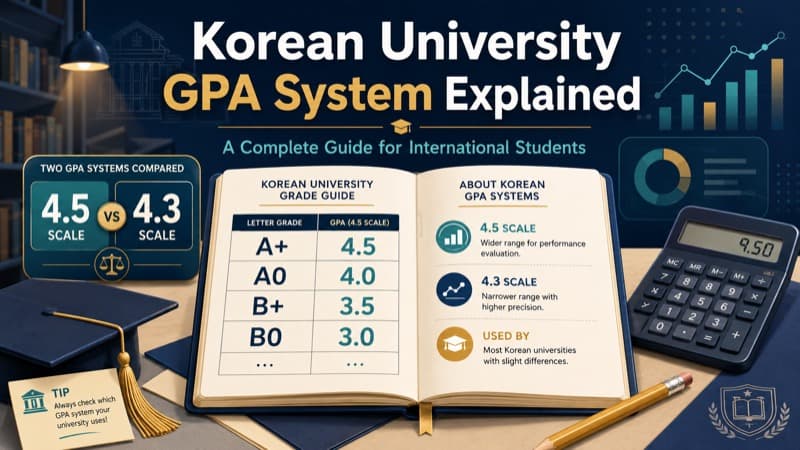
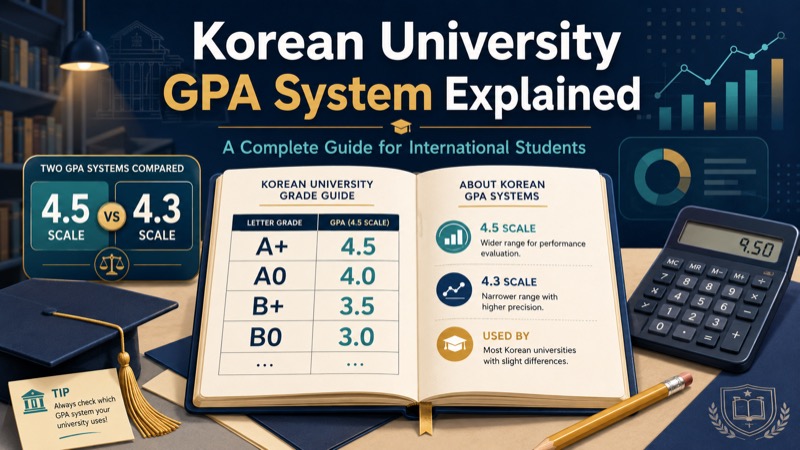
Korean universities use either a 4.5 scale or a 4.3 scale, depending on the school.
2-1. The 4.5 Scale (Most Korean Universities)
| Grade | Points | Approximate Percentage |
|---|---|---|
| A+ | 4.5 | 95–100 |
| A0 | 4.0 | 90–94 |
| B+ | 3.5 | 85–89 |
| B0 | 3.0 | 80–84 |
| C+ | 2.5 | 75–79 |
| C0 | 2.0 | 70–74 |
| D+ | 1.5 | 65–69 |
| D0 | 1.0 | 60–64 |
| F | 0.0 | Below 60 (Fail) |
Key feature: Only two sub-grades per letter — "+" and "0" (zero). "A0" is read as "A-zero" or simply "A." There are no minus grades (A−, B−, etc.).
Universities using the 4.5 scale: Korea University, Sungkyunkwan University, Hanyang University, Hankuk University of Foreign Studies, Chung-Ang University, Konkuk University, University of Seoul, Hongik University, Dongguk University, and most regional universities across Korea.
2-2. The 4.3 Scale (Some Elite Seoul Universities)
| Grade | Points |
|---|---|
| A+ | 4.3 |
| A0 | 4.0 |
| A− | 3.7 |
| B+ | 3.3 |
| B0 | 3.0 |
| B− | 2.7 |
| C+ | 2.3 |
| C0 | 2.0 |
| C− | 1.7 |
| D+ | 1.3 |
| D0 | 1.0 |
| D− | 0.7 |
| F | 0.0 |
Key feature: Grades have three sub-divisions per letter — "+", "0", and "−". This is closer to the American GPA system.
Universities using the 4.3 scale: Seoul National University, Yonsei University, Kyung Hee University, Sogang University, Ewha Womans University, Sookmyung Women's University.
💡 Worth Knowing: The 4.3 scale can be both a blessing and a curse. It offers finer grade distinctions, but the absolute number on your transcript may look lower compared to a 4.5-scale school. This becomes a real issue when applying to law schools, graduate programs, or jobs that use simple cutoffs.
2-3. The P/F (or P/NP) System (Pass/Fail)
Some courses are graded on a Pass/Fail basis instead of letter grades.
- Pass (P): Credits are earned, but not counted toward your GPA
- Fail (F/NP): No credits earned; you must retake the course
P/F courses are typically used for:
- Physical education, volunteer work, and similar liberal arts courses
- Internships and field training
- Some foreign-language elective courses
- Courses students may optionally convert to P/F (varies by school)
💡 Strategy Tip: Converting elective courses you're unsure about to P/F is a smart way to protect your GPA. However, required major courses usually cannot be converted to P/F.
3. How to Calculate Your GPA — Step by Step
Now let's get to the actual calculation.
3-1. The Basic Formula
GPA = Σ(Grade Point × Credit Hours) ÷ Total Credit Hours
In simple words: multiply each course's grade by its credit weight, add everything up, then divide by your total credit hours.
3-2. Real-World Example (4.5 Scale)
Let's say you took five courses in one semester.
| Course | Credits | Grade | Grade Point |
|---|---|---|---|
| Korean Conversation | 3 | A+ | 4.5 |
| Introduction to Business | 3 | B+ | 3.5 |
| English Writing | 2 | A0 | 4.0 |
| Understanding Korean Culture | 3 | A0 | 4.0 |
| Introduction to Statistics | 3 | B0 | 3.0 |
Step 1: Multiply Grade Point × Credits for each course
- Korean Conversation: 4.5 × 3 = 13.5
- Introduction to Business: 3.5 × 3 = 10.5
- English Writing: 4.0 × 2 = 8.0
- Understanding Korean Culture: 4.0 × 3 = 12.0
- Introduction to Statistics: 3.0 × 3 = 9.0
Step 2: Add them all up
- Sum: 13.5 + 10.5 + 8.0 + 12.0 + 9.0 = 53.0
Step 3: Divide by total credit hours
- Total credits: 3 + 3 + 2 + 3 + 3 = 14
- GPA: 53.0 ÷ 14 = 3.79
This student's semester GPA is 3.79 / 4.5.
3-3. Calculating Your Cumulative GPA
Each semester is calculated separately, but what really matters is your final cumulative GPA at graduation — that's what graduate schools and employers look at.
Your cumulative GPA fluctuates less and less as you add more semesters. A rough first semester is recoverable, but a rough senior-year semester is much harder to bounce back from.
💡 Insider Tip from an Administrator: It's normal for first-semester freshmen to have slightly lower GPAs as they adjust to university life. However, once you reach your third year, raising your GPA becomes extremely difficult. Your first two years are when GPA management matters the most.
4. Converting Your Korean GPA to Other Systems
4-1. Korean GPA → U.S. 4.0 Scale
You'll need this for U.S. graduate school applications or exchange programs.
| Korea (4.5 scale) | U.S. (4.0 scale) | Letter Grade |
|---|---|---|
| 4.5 | 4.0 | A+/A |
| 4.0 | 3.7 | A− |
| 3.5 | 3.3 | B+ |
| 3.0 | 3.0 | B |
| 2.5 | 2.7 | C+ |
| 2.0 | 2.0 | C |
This table is for reference only. For official applications, use a recognized credential evaluation service like WES (World Education Services). Each institution may have slightly different conversion standards.
4-2. Korean GPA → Percentage (out of 100)
You'll need this if your home country uses a 100-point system (Vietnam, China, parts of Southeast Asia).
General conversion formula (based on 4.5 scale):
Percentage ≈ (GPA / 4.5) × 100
But this is only a rough estimate. Korean transcripts go through letter-grade conversion and back, so the actual percentage may differ from a direct calculation.
The most accurate method: Request an official transcript from your university's academic affairs office. Many universities provide their own official conversion tables, which is what you should use for formal applications.
4-3. 4.5 Scale ↔ 4.3 Scale Conversion
This is one of the most common questions we receive, especially from students comparing GPAs across schools or applying to graduate programs.
Quick Conversion Table:
| 4.5 Scale | 4.3 Scale (approx.) |
|---|---|
| 4.5 | 4.3 |
| 4.0 | 3.85 |
| 3.5 | 3.35 |
| 3.0 | 2.85 |
| 2.5 | 2.35 |
⚠️ Warning: Because the 4.5 and 4.3 scales use fundamentally different grade structures, simple proportional conversion is not entirely accurate. For official purposes, contact your school's academic affairs office.
5. Why Your GPA Matters — Where It Actually Counts
Let me explain why GPA matters specifically for international students.
5-1. Scholarships (The Most Important Reason)
| Scholarship Type | Typical GPA Cutoff (4.5 scale) |
|---|---|
| International Student Academic Excellence Scholarship | 3.5+ |
| University Tuition Reduction Scholarships | 3.0–3.5+ |
| GKS (Global Korea Scholarship) Maintenance | 3.0+ |
| Graduation Eligibility | 2.0+ |
From an administrative perspective, scholarships for international students are often managed separately from those for Korean students, which means competition is sometimes less fierce. There are more scholarships available than most students realize — if you maintain a solid GPA.
5-2. Graduate School Admissions
For graduate school applications:
- Korean graduate programs: Usually 3.0+ recommended (top programs expect 3.5+)
- Overseas graduate programs: Usually 3.0/4.0+ (equivalent to about 3.4+ on the Korean 4.5 scale)
5-3. Employment in Korea
For international students hoping to work in Korea:
- Large Korean companies (대기업): Typically 3.0+ on the 4.5 scale (some don't post explicit cutoffs)
- Public sector / government enterprises: Usually 3.0+ or GPA bonus points
- Foreign-affiliated companies: GPA matters less; internships and experience matter more
5-4. Graduation
Most Korean universities require a minimum cumulative GPA of 2.0 for graduation. If you fall below this, your graduation may be delayed and you may need to retake courses.
6. Practical Strategies for Managing Your GPA
These are real strategies I've observed in high-performing international students over the years.
6-1. Don't Overload in Your First Semester
The most common rookie mistake: packing 21 credits into your very first semester. With Korean-language instruction and an entirely new academic environment, this is a recipe for a damaged GPA.
Recommendation: Start your first semester with 12–15 credits. Once you've adjusted, increase your load.
6-2. Take Advantage of English-Taught Courses
If your English is stronger than your Korean, prioritize English-taught courses. Many Korean universities are actively expanding these for international students.
6-3. Use the Course Retake System
At most Korean universities, you can retake courses where you scored C+ or below to replace the grade with a higher one.
Important caveats:
- The maximum grade achievable through a retake is often capped (typically at A0 or B+)
- Some schools limit the number of times you can retake courses
- You won't have time to retake courses right before graduation, so use this strategy in your 2nd or 3rd year
6-4. Use Summer/Winter Sessions to Boost Your GPA
Many Korean universities offer summer and winter sessions between regular semesters. These are typically less competitive, and grades tend to be slightly more generous.
6-5. Build Relationships with Your Professors
This is something many international students miss. In Korea, your relationship with your professors can influence your grades — not in a corrupt way, but in the universal sense that professors notice students who engage actively in class.
If asking questions during lectures feels intimidating, use office hours. Korean professors genuinely appreciate the effort, and seeing an international student make that effort often leads them to provide additional support.
7. Korean Academic Terms You Should Know
Here's a glossary of important terms you'll see on your transcript or in school documents.
| Korean Term | English Equivalent | Meaning |
|---|---|---|
| 평점평균 (평점) | GPA / Grade Point Average | Your overall average |
| 이수학점 | Credits Earned | Credits successfully completed |
| 신청학점 | Credits Registered | Credits you signed up for |
| 취득학점 | Credits Acquired | Credits you've officially received |
| 재수강 | Retaken Course | A course you repeated |
| 학기 | Semester | Spring (1st) / Fall (2nd) |
| 계절학기 | Summer/Winter Session | Short session during breaks |
| 전공 | Major | Your declared field |
| 부전공 | Minor | Secondary field of study |
| 복수전공 | Double Major | Two equal majors |
| 학적부 | Academic Record | Your official school record |
Closing Thoughts — Your GPA Is a Number, But Learning Is the Real Goal
Thank you for reading through this long guide.
I want to end with something important: GPA matters, but it isn't everything. From an administrator's perspective, I see many international students who don't have the highest GPAs but build incredible futures through internships, language proficiency, and networking.
On the flip side, I've seen students with stellar GPAs struggle after graduation because they didn't develop other skills.
Please don't measure your time in Korea purely by your GPA number. Improving your Korean, making Korean friends, experiencing Korean culture — these are assets that will pay off for the rest of your life.
That said, I'm not telling you to neglect your GPA. It is, after all, the first gate to scholarships, graduate school, and employment. The key is balance.
I wish you the best on your journey through Korean university life.
📚 Useful Official Resources
- Your University's Academic Affairs Office: For exact grading regulations specific to your school (check your school's website)
- Study in Korea (Official Korean Government Portal): https://www.studyinkorea.go.kr
- WES (World Education Services) (Official Credential Evaluation): https://www.wes.org
You may also like
- 5 Mistakes International Students Make at Korean Universities (Told by a University Staff Member)
- Your First 30 Days in Korea: The Essential Admin Checklist for International Students
- GKS Scholarship 2026: Insider Tips from a Korean University Admin Office
Daruharu TV — A Korean university staff member's honest guide to studying in Korea
You may also like


Related Posts

Who Should You Contact at a Korean University? A Guide to Campus Offices
"Please contact another office." Finding the right person at a Korean university can feel like an extra assignment. Here is how to identify the responsible office, write a message that gets answered, and keep the conversation moving when you are redirected.

Using AI to Understand Korean University Notices: What to Double-Check
AI can translate a Korean university notice in seconds — and make an uncertain interpretation sound settled. Here is how to let AI organize the notice while keeping the original as the reference, plus a reusable prompt and a verification checklist.

An HWP or HWPX File Won't Open? Here's What to Do in Korea
Your school sends a form and it will not open — the filename ends in HWP or HWPX. What it is, when a free viewer is enough, when to ask your school first, and how to avoid buying software you may not need.